Why Sleep Duration Doesn’t Matter (If You Ignore This One Thing)
Waking up at 3 AM may not be random. New research suggests that inconsistent sleep timing, even more than sleep duration, could disrupt your circadian rhythm,…
Medical Disclaimer: This article is for educational purposes only and does not constitute medical advice, diagnosis, or treatment. Always consult with a qualified healthcare provider before making changes to your sleep routine or if you have concerns about your cardiovascular health.
Everyone obsesses over getting eight hours of sleep. You’ve probably asked yourself a hundred times: “Did I get enough sleep last night?” But new research tracking over 60,000 people for seven years reveals that you might be asking the wrong question entirely.
It’s not how long you sleep that could predict your risk of heart disease and early death. It’s when you sleep.
The Sleep Regularity Discovery
A groundbreaking study published in the journal Sleep analyzed data from 60,977 adults in the UK Biobank over a seven year period. The researchers weren’t looking at sleep duration. They were measuring something called the Sleep Regularity Index, or SRI, essentially how consistent your bedtime and wake time are from day to day.
What they found was striking. People with irregular sleep schedules had a 26% higher risk of major cardiovascular events like heart attacks and strokes compared to those with regular sleep patterns. This increased risk held true even for people who were getting the recommended seven to nine hours of sleep each night.
Think about that for a moment. You could be hitting your eight hour target every single night, but if you’re going to bed at 10 PM on Tuesday and midnight on Thursday, your heart could be paying the price.
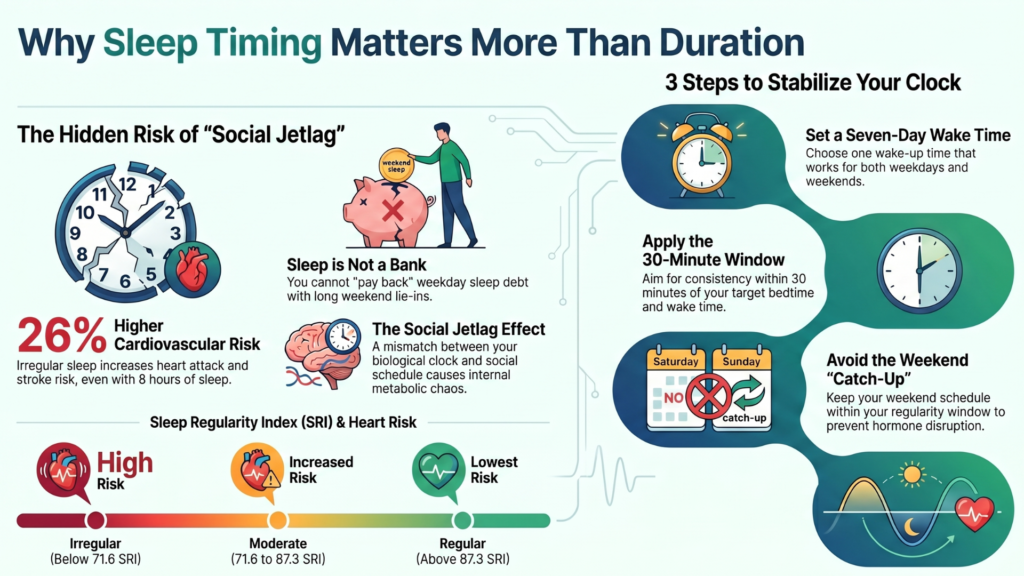
Infographic: Why sleep timing may matter more than duration, and how irregular schedules
can disrupt your body clock.
Why Your Body Cares About Timing More Than Duration
Your body runs on an internal 24-hour clock called your circadian rhythm. This biological timekeeper regulates everything from your hormone production to your blood pressure to your metabolism. When you go to bed and wake up at consistent times, you’re working with this natural rhythm. When your sleep timing bounces around, you’re fighting against it.
Matthew Pase, the lead researcher from Monash University, explains it clearly: “Sleep is not like the bank. You can’t accumulate a debt and pay it all back on the weekend and think everything’s going to be fine.”
That weekend sleep-in you’ve been using to “catch up” on lost sleep during the week? It might not just be ineffective. It could be actively disrupting your body’s ability to maintain healthy cardiovascular function.
The irregular sleep pattern creates what researchers call social jetlag, the mismatch between your biological clock and your social schedule. Your body experiences this the same way it would experience flying across time zones, except you’re doing it to yourself every single week.
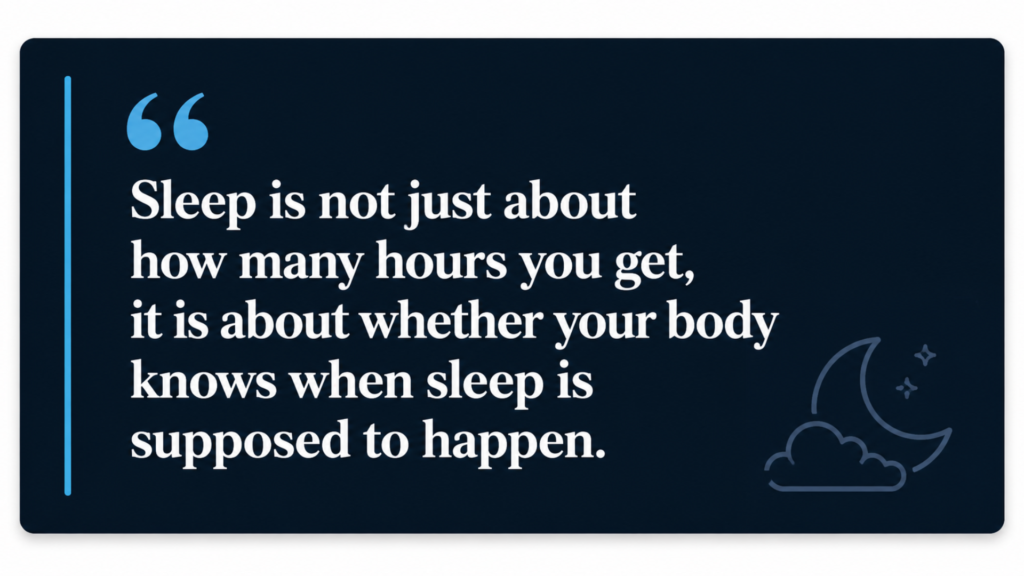
Sleep quality is not only determined by how long you sleep, but by whether your body can
maintain a stable and predictable rhythm.
What the Numbers Actually Mean
The Sleep Regularity Index works on a scale where perfect consistency (going to bed and waking up at exactly the same time every day) scores 100, and complete irregularity scores 0. The study found that people who scored in the irregular range (SRI below 71.6) had significantly worse health outcomes than those in the moderate (71.6 to 87.3) or regular (above 87.3) ranges.
Here’s what makes this particularly important: even when researchers controlled for sleep duration, meaning they compared people who all got seven to nine hours, the irregular sleepers still had worse cardiovascular outcomes. Getting enough hours didn’t protect them if those hours happened at wildly different times each day.
The study also revealed that only 61% of participants with irregular sleep were actually meeting the recommended sleep duration guidelines, compared to 68% of those with moderately irregular sleep. But duration alone didn’t determine health risk. Timing consistency did.
Why Weekend Catch-Up Sleep Could Backfire
If you’re like most people, your weekday alarm goes off at 6 AM, but on Saturday you sleep until 9 or 10. That three to four hour difference might feel like a luxury you’ve earned, but your cardiovascular system could be registering it as chaos.
When you shift your wake time by several hours on the weekend, you’re forcing your body to adjust its hormone production, blood pressure regulation, and metabolic processes. Your cortisol (the wake-up hormone) is supposed to peak around your normal wake time. When you sleep in, that timing gets disrupted. Your body doesn’t know whether to prepare for a 6 AM wake-up or a 10 AM wake-up, so your internal systems lose their coordination.
This isn’t just theory. The UK Biobank data showed that people with the most irregular sleep patterns, the ones doing the biggest weekend catch-up sessions, had the highest rates of heart disease over the seven year study period.
How to Build Sleep Regularity (Even If Your Schedule Isn’t Perfect)
The good news is that improving your sleep regularity doesn’t require a complete life overhaul. You don’t need to quit your job or abandon your social life. You just need to tighten your consistency window.
Start by calculating your ideal seven day wake time. This is the wake time that works for both weekdays and weekends. If you absolutely must be up by 6 AM for work Monday through Friday, but you’d naturally sleep until 9 AM on weekends, your compromise wake time might be 7 AM. That’s late enough to give you a bit of weekend rest, but early enough that it doesn’t completely throw off your weekday rhythm.
You can use our Sleep Calculator to help figure out your optimal sleep and wake times based on your personal needs. It takes into account sleep cycles and helps you find a schedule that actually works for your life.
Once you have your seven day wake time, work backwards seven to eight hours (depending on how much sleep you personally need) to find your target bedtime. If you’re waking at 7 AM and need eight hours, you’re aiming for an 11 PM bedtime.
Now here’s the key: give yourself a 30 minute window on either side. Your goal isn’t robotic precision. It’s reasonable consistency. Going to bed between 10:30 PM and 11:30 PM, and waking between 6:30 AM and 7:30 AM, will keep you in the regular range of the Sleep Regularity Index.
Track your actual bed and wake times for two weeks before you judge whether this is working. Use your phone’s clock app, a simple notebook, or any sleep tracking device you already own. You’re not tracking sleep quality or sleep stages, just the times you go to bed and the times you wake up.
If you miss your window one night (because life happens), don’t try to “make up” for it the next night by sleeping extra late or extra early. Just get back to your regular schedule. Remember: sleep is not a bank. You can’t balance the books with one big correction.

Stable sleep timing helps your brain anticipate rest, making it easier to fall asleep, stay asleep,
and wake feeling restored.
What to Expect When You Regularize Your Sleep
In the first week, you might feel like you’re fighting your natural tendencies. If you’ve been sleeping in until 10 AM every Saturday for the past five years, waking up at 7 AM on a weekend is going to feel wrong. That’s completely normal.
By week two, your body starts adapting. You’ll probably notice you’re getting sleepy closer to your target bedtime, even on nights when you used to stay up late. That’s your circadian rhythm beginning to lock in.
By week three or four, most people report feeling more consistently energized during the day. The mid-afternoon crashes get less severe. The morning grogginess fades faster. This is what it feels like when your cardiovascular system, hormone production, and metabolic processes are all running on the same schedule instead of constantly trying to catch up to wherever you decided to sleep that day.
The cardiovascular benefits, the reduced risk of heart attack and stroke that the study measured, take longer to show up. But they could be building in the background every single day you maintain that consistency.
When Sleep Regularity Might Not Be Enough
Sleep timing consistency is important, but it’s not the only factor in cardiovascular health. If you’re maintaining a regular sleep schedule but still experiencing symptoms like excessive daytime sleepiness, loud snoring, morning headaches, or witnessed breathing pauses during sleep, you might want to talk to your doctor. These could indicate sleep apnea or other sleep disorders that may require medical treatment.
Similarly, if you’re dealing with insomnia, difficulty falling asleep or staying asleep despite having the opportunity and environment for sleep, a regular schedule is part of the solution, but you might also want to consider cognitive behavioral therapy for insomnia or other targeted approaches.
The research on sleep regularity gives us a powerful, actionable target. But it doesn’t replace the need for adequate sleep duration, good sleep quality, or treatment of underlying sleep disorders.
The Bottom Line on Sleep Timing
Stop counting hours like you’re tracking a quota. Start protecting your sleep window like you’d protect any other important appointment. Your 11 PM bedtime and 7 AM wake time aren’t suggestions, they’re the framework that could let your cardiovascular system function the way it’s designed to.
The 60,000-person study makes the stakes clear: irregular sleep increases your risk of heart disease by 26%, and that risk doesn’t go away just because you got eight hours. Your heart doesn’t care if you slept enough. It cares if you slept at the same time as yesterday.
Pick your seven-day wake time. Work backwards to find your bedtime. Give yourself a 30-minute consistency window. Track it for two weeks. Use our Sleep Calculator if you need help figuring out the timing that works for you.
Sleep is not a bank. You can’t make deposits and withdrawals and expect your body to balance the books. You can only show up at the same time, day after day, and let your circadian rhythm do what it was designed to do.
Frequently Asked Questions About Sleep Timing and 3 AM Wake-Ups
Why do I keep waking up at 3 AM every night?
Waking up around 3 AM can feel random, but biologically, it often isn’t. This is a time of night when your sleep naturally becomes lighter, melatonin may be starting to decline, and cortisol may slowly begin rising as your body prepares for morning. If your sleep schedule has been inconsistent, that 3 AM window can become even more vulnerable.
Is sleep timing more important than sleep duration?
Sleep duration still matters, but timing may be the part many people overlook. You can get enough hours and still confuse your body if your bedtime and wake time are changing all the time. Your body does best when it can predict when sleep is supposed to happen.
What is social jetlag?
Social jetlag is what happens when your weekday sleep schedule and weekend sleep schedule are very different. For example, waking up at 6 AM during the week and then sleeping until 10 AM on Saturday may feel like catching up, but your body can experience that timing shift almost like internal jet lag.
Can irregular sleep schedules affect heart health?
Research suggests that irregular sleep timing may be linked to higher cardiovascular risk. The reason may be that your circadian rhythm helps regulate things like blood pressure, metabolism, inflammation, and hormone timing. When your sleep schedule keeps shifting, those systems may lose some of their coordination.
How long does it take to fix an irregular sleep schedule?
For some people, small improvements may show up within one or two weeks of keeping a more consistent wake-up time. But if your schedule has been irregular for years, it may take longer for your body to fully adjust. The goal is not perfection. The goal is giving your body a rhythm it can trust.
Should I take melatonin if I wake up at 3 AM?
For many people, taking melatonin in the middle of the night is not the best fit, because melatonin is more of a timing signal than a knockout sleep pill. If you already took it before bed, the better focus may be calming your nervous system, keeping lights low, and helping your body settle back into sleep. If this happens often or feels severe, it is worth talking with a healthcare professional.
What is the best way to stabilize my sleep schedule?
Start with your wake-up time. That is usually the strongest anchor for your body clock. Try to wake up within a consistent window every day, get morning light when you can, and avoid big weekend sleep-ins that shift your rhythm too far. Small, steady changes are often more helpful than trying to force a perfect sleep routine overnight.
Medical Disclaimer: This article is for educational purposes only and does not constitute medical advice, diagnosis, or treatment. The information presented is based on published research but should not replace consultation with qualified healthcare providers. If you have concerns about your sleep patterns, cardiovascular health, or any medical condition, please consult with your doctor or a sleep specialist.
Sources:
Windred, D.P., et al. “Sleep regularity and mortality: a prospective analysis in the UK Biobank.” Sleep, November 2024.
Phillips, A.J.K., et al. “Irregular sleep/wake patterns are associated with poorer academic performance and delayed circadian and sleep/wake timing.” Scientific Reports, 2017.
1. Circadian Rhythm Background
National Institute of General Medical Sciences – Circadian Rhythms Fact Sheet
2. Social Jetlag Research
Wittmann, M., et al. “Social jetlag: misalignment of biological and social time.” Chronobiology International, 2006.
3. Cardiovascular Health & Sleep
American Heart Association – Sleep Duration and Quality: Impact on Lifestyle Behaviors
4. Sleep Regularity Index Methodology
Phillips, A.J.K., et al. “Irregular sleep/wake patterns are associated with poorer academic performance.” Scientific Reports, 2017.
- Link: https://www.nature.com/articles/s41598-017-03171-4
- Where to use: In the “What the Numbers Actually Mean” section when explaining the SRI scale
5. Mayo Clinic – Sleep Guidelines
Mayo Clinic – How many hours of sleep are enough for good health?