SleepWellCalculator Logo

Category: Sleep Science

  • Why Sleep Duration Doesn’t Matter (If You Ignore This One Thing)

    Why Sleep Duration Doesn’t Matter (If You Ignore This One Thing)

    Medical Disclaimer: This article is for educational purposes only and does not constitute medical advice, diagnosis, or treatment. Always consult with a qualified healthcare provider before making changes to your sleep routine or if you have concerns about your cardiovascular health.

    Everyone obsesses over getting eight hours of sleep. You’ve probably asked yourself a hundred times: “Did I get enough sleep last night?” But new research tracking over 60,000 people for seven years reveals that you might be asking the wrong question entirely.

    It’s not how long you sleep that could predict your risk of heart disease and early death. It’s when you sleep.

    The Sleep Regularity Discovery

    A groundbreaking study published in the journal Sleep analyzed data from 60,977 adults in the UK Biobank over a seven year period. The researchers weren’t looking at sleep duration. They were measuring something called the Sleep Regularity Index, or SRI, essentially how consistent your bedtime and wake time are from day to day.

    What they found was striking. People with irregular sleep schedules had a 26% higher risk of major cardiovascular events like heart attacks and strokes compared to those with regular sleep patterns. This increased risk held true even for people who were getting the recommended seven to nine hours of sleep each night.

    Think about that for a moment. You could be hitting your eight hour target every single night, but if you’re going to bed at 10 PM on Tuesday and midnight on Thursday, your heart could be paying the price.
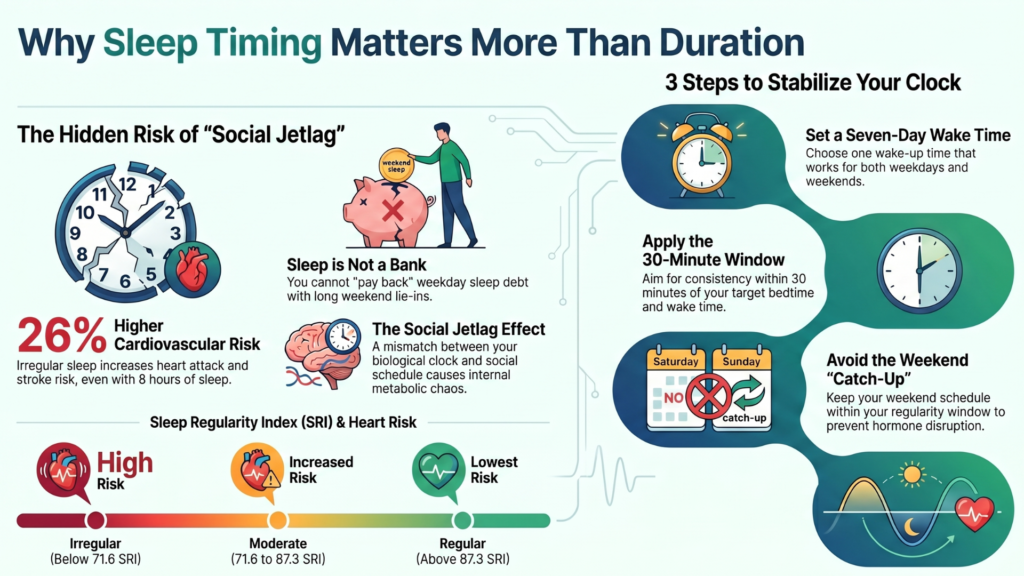
    Infographic: Why sleep timing may matter more than duration, and how irregular schedules
    can disrupt your body clock.


    Why Your Body Cares About Timing More Than Duration

    Your body runs on an internal 24-hour clock called your circadian rhythm. This biological timekeeper regulates everything from your hormone production to your blood pressure to your metabolism. When you go to bed and wake up at consistent times, you’re working with this natural rhythm. When your sleep timing bounces around, you’re fighting against it.

    Matthew Pase, the lead researcher from Monash University, explains it clearly: “Sleep is not like the bank. You can’t accumulate a debt and pay it all back on the weekend and think everything’s going to be fine.”

    That weekend sleep-in you’ve been using to “catch up” on lost sleep during the week? It might not just be ineffective. It could be actively disrupting your body’s ability to maintain healthy cardiovascular function.

    The irregular sleep pattern creates what researchers call social jetlag, the mismatch between your biological clock and your social schedule. Your body experiences this the same way it would experience flying across time zones, except you’re doing it to yourself every single week.
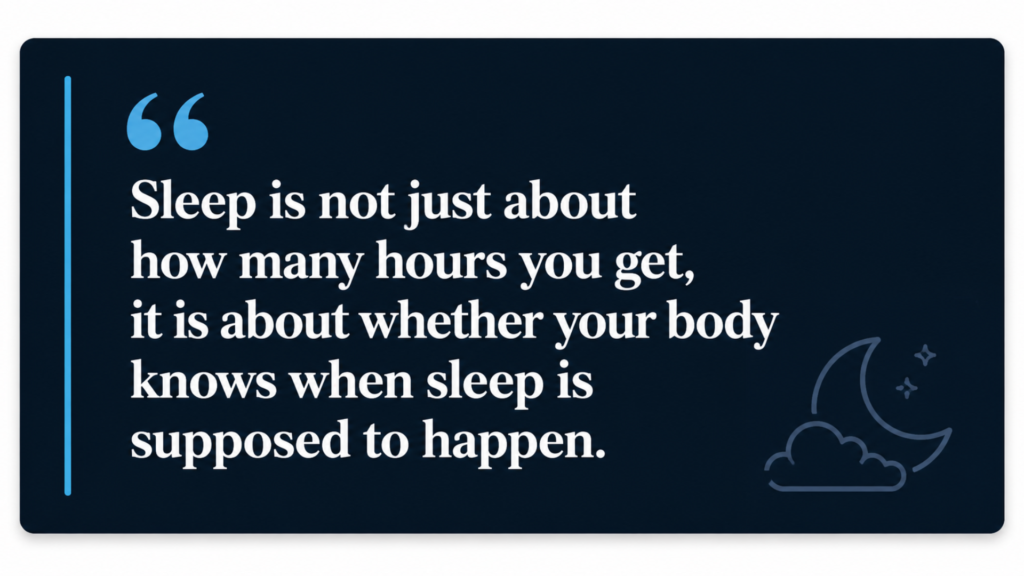
    Sleep quality is not only determined by how long you sleep, but by whether your body can
    maintain a stable and predictable rhythm.


    What the Numbers Actually Mean

    The Sleep Regularity Index works on a scale where perfect consistency (going to bed and waking up at exactly the same time every day) scores 100, and complete irregularity scores 0. The study found that people who scored in the irregular range (SRI below 71.6) had significantly worse health outcomes than those in the moderate (71.6 to 87.3) or regular (above 87.3) ranges.

    Here’s what makes this particularly important: even when researchers controlled for sleep duration, meaning they compared people who all got seven to nine hours, the irregular sleepers still had worse cardiovascular outcomes. Getting enough hours didn’t protect them if those hours happened at wildly different times each day.

    The study also revealed that only 61% of participants with irregular sleep were actually meeting the recommended sleep duration guidelines, compared to 68% of those with moderately irregular sleep. But duration alone didn’t determine health risk. Timing consistency did.

    Why Weekend Catch-Up Sleep Could Backfire

    If you’re like most people, your weekday alarm goes off at 6 AM, but on Saturday you sleep until 9 or 10. That three to four hour difference might feel like a luxury you’ve earned, but your cardiovascular system could be registering it as chaos.

    When you shift your wake time by several hours on the weekend, you’re forcing your body to adjust its hormone production, blood pressure regulation, and metabolic processes. Your cortisol (the wake-up hormone) is supposed to peak around your normal wake time. When you sleep in, that timing gets disrupted. Your body doesn’t know whether to prepare for a 6 AM wake-up or a 10 AM wake-up, so your internal systems lose their coordination.

    This isn’t just theory. The UK Biobank data showed that people with the most irregular sleep patterns, the ones doing the biggest weekend catch-up sessions, had the highest rates of heart disease over the seven year study period.

    How to Build Sleep Regularity (Even If Your Schedule Isn’t Perfect)

    The good news is that improving your sleep regularity doesn’t require a complete life overhaul. You don’t need to quit your job or abandon your social life. You just need to tighten your consistency window.

    Start by calculating your ideal seven day wake time. This is the wake time that works for both weekdays and weekends. If you absolutely must be up by 6 AM for work Monday through Friday, but you’d naturally sleep until 9 AM on weekends, your compromise wake time might be 7 AM. That’s late enough to give you a bit of weekend rest, but early enough that it doesn’t completely throw off your weekday rhythm.

    You can use our Sleep Calculator to help figure out your optimal sleep and wake times based on your personal needs. It takes into account sleep cycles and helps you find a schedule that actually works for your life.

    Once you have your seven day wake time, work backwards seven to eight hours (depending on how much sleep you personally need) to find your target bedtime. If you’re waking at 7 AM and need eight hours, you’re aiming for an 11 PM bedtime.

    Now here’s the key: give yourself a 30 minute window on either side. Your goal isn’t robotic precision. It’s reasonable consistency. Going to bed between 10:30 PM and 11:30 PM, and waking between 6:30 AM and 7:30 AM, will keep you in the regular range of the Sleep Regularity Index.

    Track your actual bed and wake times for two weeks before you judge whether this is working. Use your phone’s clock app, a simple notebook, or any sleep tracking device you already own. You’re not tracking sleep quality or sleep stages, just the times you go to bed and the times you wake up.

    If you miss your window one night (because life happens), don’t try to “make up” for it the next night by sleeping extra late or extra early. Just get back to your regular schedule. Remember: sleep is not a bank. You can’t balance the books with one big correction.

    Stable sleep timing helps your brain anticipate rest, making it easier to fall asleep, stay asleep,
    and wake feeling restored.


    What to Expect When You Regularize Your Sleep

    In the first week, you might feel like you’re fighting your natural tendencies. If you’ve been sleeping in until 10 AM every Saturday for the past five years, waking up at 7 AM on a weekend is going to feel wrong. That’s completely normal.

    By week two, your body starts adapting. You’ll probably notice you’re getting sleepy closer to your target bedtime, even on nights when you used to stay up late. That’s your circadian rhythm beginning to lock in.

    By week three or four, most people report feeling more consistently energized during the day. The mid-afternoon crashes get less severe. The morning grogginess fades faster. This is what it feels like when your cardiovascular system, hormone production, and metabolic processes are all running on the same schedule instead of constantly trying to catch up to wherever you decided to sleep that day.

    The cardiovascular benefits, the reduced risk of heart attack and stroke that the study measured, take longer to show up. But they could be building in the background every single day you maintain that consistency.

    When Sleep Regularity Might Not Be Enough

    Sleep timing consistency is important, but it’s not the only factor in cardiovascular health. If you’re maintaining a regular sleep schedule but still experiencing symptoms like excessive daytime sleepiness, loud snoring, morning headaches, or witnessed breathing pauses during sleep, you might want to talk to your doctor. These could indicate sleep apnea or other sleep disorders that may require medical treatment.

    Similarly, if you’re dealing with insomnia, difficulty falling asleep or staying asleep despite having the opportunity and environment for sleep, a regular schedule is part of the solution, but you might also want to consider cognitive behavioral therapy for insomnia or other targeted approaches.

    The research on sleep regularity gives us a powerful, actionable target. But it doesn’t replace the need for adequate sleep duration, good sleep quality, or treatment of underlying sleep disorders.

    The Bottom Line on Sleep Timing

    Stop counting hours like you’re tracking a quota. Start protecting your sleep window like you’d protect any other important appointment. Your 11 PM bedtime and 7 AM wake time aren’t suggestions, they’re the framework that could let your cardiovascular system function the way it’s designed to.

    The 60,000-person study makes the stakes clear: irregular sleep increases your risk of heart disease by 26%, and that risk doesn’t go away just because you got eight hours. Your heart doesn’t care if you slept enough. It cares if you slept at the same time as yesterday.

    Pick your seven-day wake time. Work backwards to find your bedtime. Give yourself a 30-minute consistency window. Track it for two weeks. Use our Sleep Calculator if you need help figuring out the timing that works for you.

    Sleep is not a bank. You can’t make deposits and withdrawals and expect your body to balance the books. You can only show up at the same time, day after day, and let your circadian rhythm do what it was designed to do.

    Frequently Asked Questions About Sleep Timing and 3 AM Wake-Ups

    Why do I keep waking up at 3 AM every night?

    Waking up around 3 AM can feel random, but biologically, it often isn’t. This is a time of night when your sleep naturally becomes lighter, melatonin may be starting to decline, and cortisol may slowly begin rising as your body prepares for morning. If your sleep schedule has been inconsistent, that 3 AM window can become even more vulnerable.

    Is sleep timing more important than sleep duration?

    Sleep duration still matters, but timing may be the part many people overlook. You can get enough hours and still confuse your body if your bedtime and wake time are changing all the time. Your body does best when it can predict when sleep is supposed to happen.

    What is social jetlag?

    Social jetlag is what happens when your weekday sleep schedule and weekend sleep schedule are very different. For example, waking up at 6 AM during the week and then sleeping until 10 AM on Saturday may feel like catching up, but your body can experience that timing shift almost like internal jet lag.

    Can irregular sleep schedules affect heart health?

    Research suggests that irregular sleep timing may be linked to higher cardiovascular risk. The reason may be that your circadian rhythm helps regulate things like blood pressure, metabolism, inflammation, and hormone timing. When your sleep schedule keeps shifting, those systems may lose some of their coordination.

    How long does it take to fix an irregular sleep schedule?

    For some people, small improvements may show up within one or two weeks of keeping a more consistent wake-up time. But if your schedule has been irregular for years, it may take longer for your body to fully adjust. The goal is not perfection. The goal is giving your body a rhythm it can trust.

    Should I take melatonin if I wake up at 3 AM?

    For many people, taking melatonin in the middle of the night is not the best fit, because melatonin is more of a timing signal than a knockout sleep pill. If you already took it before bed, the better focus may be calming your nervous system, keeping lights low, and helping your body settle back into sleep. If this happens often or feels severe, it is worth talking with a healthcare professional.

    What is the best way to stabilize my sleep schedule?

    Start with your wake-up time. That is usually the strongest anchor for your body clock. Try to wake up within a consistent window every day, get morning light when you can, and avoid big weekend sleep-ins that shift your rhythm too far. Small, steady changes are often more helpful than trying to force a perfect sleep routine overnight.

    Medical Disclaimer: This article is for educational purposes only and does not constitute medical advice, diagnosis, or treatment. The information presented is based on published research but should not replace consultation with qualified healthcare providers. If you have concerns about your sleep patterns, cardiovascular health, or any medical condition, please consult with your doctor or a sleep specialist.

    Sources:

    Windred, D.P., et al.Sleep regularity and mortality: a prospective analysis in the UK Biobank.” Sleep, November 2024.

    Phillips, A.J.K., et al. “Irregular sleep/wake patterns are associated with poorer academic performance and delayed circadian and sleep/wake timing.” Scientific Reports, 2017.

    1. Circadian Rhythm Background

    National Institute of General Medical Sciences – Circadian Rhythms Fact Sheet

    2. Social Jetlag Research

    Wittmann, M., et al. “Social jetlag: misalignment of biological and social time.” Chronobiology International, 2006.

    3. Cardiovascular Health & Sleep

    American Heart Association – Sleep Duration and Quality: Impact on Lifestyle Behaviors

    4. Sleep Regularity Index Methodology

    Phillips, A.J.K., et al. “Irregular sleep/wake patterns are associated with poorer academic performance.” Scientific Reports, 2017.

    5. Mayo Clinic – Sleep Guidelines

    Mayo Clinic – How many hours of sleep are enough for good health?
  • The 3-2-1 Sleep Rule That Actually Works (and Why)

    The 3-2-1 Sleep Rule That Actually Works (and Why)

    Medical Disclaimer: This article is for informational purposes only and is not a substitute for professional medical advice, diagnosis, or treatment. Always consult your physician or other qualified healthcare provider with any questions you may have regarding a medical condition.

    Everyone’s talking about the 3-2-1 sleep rule like it’s some miracle cure. Here’s the thing: it works, but not for the reasons you think.

    If you’ve been scrolling through sleep advice on social media, you’ve probably seen this formula pop up everywhere: stop eating 3 hours before bed, stop drinking liquids 2 hours before bed, and stop screen time 1 hour before bed. It sounds simple enough. And yes, it can absolutely help you sleep better.

    But before you set a bunch of new alarms and stress yourself out trying to follow yet another wellness rule perfectly, let’s talk about what’s actually happening in your body and why this timing matters.


    What Is the 3-2-1 Sleep Rule?

    The 3-2-1 sleep rule is a sleep hygiene framework that structures your evening routine around three time-based boundaries:

    • 3 hours before bed: Stop eating large meals
    • 2 hours before bed: Stop drinking fluids
    • 1 hour before bed: Stop all screen time

    The idea is that by creating these buffers, you’re giving your body the time it needs to process food, avoid middle-of-the-night bathroom trips, and let your brain shift out of alert mode before sleep.

    It’s not a prescription. It’s a guideline. And like most sleep advice, it works best when you understand the science behind it so you can adapt it to your actual life.

    The Science of the 3-2-1 Sleep Rule infographic showing the three biological systems affected: digestion (3 hours), hydration (2 hours), and melatonin/screen light (1 hour)
    The 3-2-1 rule aligns the body’s internal systems — temperature, hydration, and hormones — for deep, restorative sleep by mitigating common sleep disruptors.

    The 3-Hour Food Cutoff: Why Late-Night Eating Disrupts Sleep

    Let’s start with the food rule, because this is the one that trips people up the most.

    Eating a heavy meal close to bedtime forces your digestive system to work overtime right when your body is trying to power down for sleep. According to the American Academy of Sleep Medicine, late-night eating can interfere with your body’s natural circadian rhythm and make it harder to fall asleep. When your digestive system is actively processing food, your core body temperature stays elevated, which works against the natural temperature drop your body needs to initiate sleep.

    The Cleveland Clinic notes that lying down shortly after eating can also trigger acid reflux and heartburn, especially if you’ve eaten spicy, fatty, or acidic foods. That burning sensation in your chest isn’t exactly sleep-friendly.

    Here’s what most people miss: the 3-hour rule isn’t about starving yourself. It’s about giving your stomach enough time to move food through the initial stages of digestion before you lie down. A light snack an hour before bed — like a small handful of nuts or a banana — won’t derail your sleep the way a full dinner at 9 PM will.

    The goal is to avoid going to bed feeling stuffed, bloated, or uncomfortably full.


    The 2-Hour Hydration Cutoff: Balancing Sleep and Bathroom Trips

    The second part of the rule is about fluid intake, and this one requires a little nuance.

    Drinking too much water or other liquids close to bedtime increases the likelihood that you’ll wake up in the middle of the night needing to use the bathroom. The Mayo Clinic points out that nocturia (waking up to urinate during the night) is a common sleep disruptor, and it becomes more frequent as we age.

    Here’s the reality: you don’t want to go to bed thirsty, and you definitely don’t want to become dehydrated overnight. But chugging a giant water bottle at 10 PM is going to send you stumbling to the bathroom at 2 AM.

    The 2-hour guideline gives your kidneys time to process fluids so your bladder isn’t full right when you’re hitting your deepest sleep stages. If you’re thirsty closer to bedtime, take small sips. Don’t chug. And if you wake up thirsty in the night, that’s usually a sign you need to hydrate better during the day — not right before bed.

    One important note: if you’re on medications that require evening doses with water, obviously don’t skip that. The 2-hour rule is a suggestion, not a medical mandate.


    The 1-Hour Screen Time Cutoff: Blue Light and Brain Activation

    Now we get to the part that everyone knows they should do but almost nobody actually does: putting away screens an hour before bed.

    The National Institutes of Health explains that blue light exposure from phones, tablets, and computers suppresses melatonin production. Melatonin is the hormone that signals to your brain that it’s time to sleep. When you scroll Instagram or watch YouTube videos late into the night, you’re actively telling your brain to stay awake — even if you feel physically tired.

    But it’s not just the light. It’s also the content. Checking work emails, reading stressful news, or getting into arguments in the comments section keeps your brain in a heightened state of alertness. Your nervous system doesn’t distinguish between a real threat and a Twitter argument. It just knows something activated your fight-or-flight response, and now you’re wired.

    The American Academy of Sleep Medicine recommends creating a consistent pre-sleep routine that doesn’t involve screens. That could mean reading a physical book, doing some light stretching, journaling, or listening to calming music. The point is to give your brain a clear signal that the day is over and it’s time to wind down.

    If completely avoiding screens isn’t realistic for you, consider using blue light blocking glasses starting in the evening. These amber-tinted glasses filter out the blue wavelengths that suppress melatonin production, allowing you to use devices without the same sleep-disrupting impact. While they won’t solve the mental stimulation problem, they do address the biological light exposure issue.


    Does the 3-2-1 Rule Actually Work?

    Yes, but not because it’s magic.

    The 3-2-1 rule works because it’s a simple, memorable framework that addresses three of the most common sleep disruptors: digestive discomfort, nighttime bathroom trips, and overstimulation from screens. It’s not groundbreaking science. It’s just smart sleep hygiene packaged in a way that’s easy to remember.

    The real power of this rule is that it forces you to be intentional about your evening routine. Instead of eating dinner at 9 PM, scrolling until midnight, and wondering why you can’t fall asleep, you’re creating a structured wind-down period that supports your body’s natural sleep drive.

    Will it fix chronic insomnia? No. Will it cure a sleep disorder? Absolutely not. But for the average person who’s struggling with inconsistent sleep because of poor evening habits, this rule can be a genuine game-changer.


    How to Actually Use the 3-2-1 Rule in Real Life

    Let’s say your ideal bedtime is 11 PM. Here’s what your evening would look like:

    • 8 PM: Last full meal or snack
    • 9 PM: Last significant fluid intake (small sips after this are fine)
    • 10 PM: Screens off, wind-down routine begins

    If that feels too rigid, adjust it. The exact timing matters less than the principle: create separation between stimulating activities and sleep.

    Some people do better with a 2-1-1 rule. Some people need a full 4 hours after eating. The point is to experiment and find what works for your body, your schedule, and your life.

    Use our Sleep Schedule Calculator to figure out your optimal bedtime based on when you need to wake up, then work backward to structure your evening routine.


    What If You Can’t Follow the 3-2-1 Rule Perfectly?

    You don’t have to.

    Life happens. You’re going to have late dinners. You’re going to check your phone before bed. You’re going to drink water at 10:30 PM because you’re thirsty. The 3-2-1 rule is a tool, not a test. If you can follow it most nights, you’ll see improvement. If you can only manage one piece of it — like ditching screens an hour before bed — that’s still progress.

    The worst thing you can do is stress about not following a sleep rule perfectly, because that stress will keep you awake longer than the screen time ever would.


    🎧 Listen: Why the 3-2-1 Sleep Rule Works

    Prefer to listen? Here’s a deep-dive audio discussion on the science behind the 3-2-1 rule.


    Frequently Asked Questions

    Can I eat a snack within 3 hours of bedtime?

    Yes. A light snack like a banana, a small handful of almonds, or some yogurt won’t disrupt your sleep the way a heavy meal will. The goal is to avoid large, rich, or spicy meals close to bedtime that require significant digestive effort.

    What if I get thirsty after the 2-hour cutoff?

    Take small sips of water. The 2-hour rule is about avoiding large amounts of fluid that will fill your bladder and wake you up later. If you’re genuinely thirsty, hydrate. Just don’t chug a full glass.

    Does the type of screen matter for the 1-hour rule?

    All screens emit blue light, but some devices — like e-readers with warm light settings or phones with night mode enabled — are less disruptive than bright tablets or computer monitors. Blue light blocking glasses worn in the evening can also help filter out the sleep-disrupting wavelengths. That said, it’s not just the light that’s the problem. It’s also the mental stimulation from the content you’re consuming.

    What should I do during the 1-hour screen-free window?

    Read a physical book, take a warm bath or shower, do some light stretching or yoga, journal, listen to calming music or a sleep meditation, or practice deep breathing exercises. The goal is to engage in activities that relax your mind and body.

    How long does it take to see results from following the 3-2-1 rule?

    Some people notice improvements within a few days, especially if poor evening habits were a major factor in their sleep struggles. For others, it may take a week or two of consistency. Sleep is cumulative, so stick with it even if you don’t see instant results.

    Is the 3-2-1 rule backed by science?

    The individual components — avoiding late meals, limiting fluids before bed, and reducing blue light exposure — are all supported by sleep research. The “3-2-1” framework itself is more of a practical guideline than a formal scientific protocol, but it’s based on evidence-based sleep hygiene principles.


    Citations

    American Academy of Sleep Medicine – Healthy Sleep Habits

    Mayo Clinic – Sleep Tips

    National Institutes of Health – Blue Light and Sleep

    Cleveland Clinic – How to Fall Asleep


    Ready to build a sleep schedule that actually works? Use our Sleep Schedule Calculator to find your optimal bedtime and wake time based on your natural sleep cycles.

    Want more science-backed sleep strategies? Subscribe to our YouTube channel for weekly videos breaking down the research you actually need to know.

    Medical Disclaimer: This article is for informational purposes only and is not a substitute for professional medical advice, diagnosis, or treatment. Always seek the advice of your physician or other qualified health provider with any questions you may have regarding a medical condition.

  • Why You Keep Waking Up at 3AM (And What Your Brain Is Actually Doing)

    Why You Keep Waking Up at 3AM (And What Your Brain Is Actually Doing)

    Medical Disclaimer: This article is for informational purposes only and is not intended as medical advice. If you are experiencing chronic sleep difficulties, please consult a qualified healthcare provider.

    Waking up at 3AM can feel random, frustrating, and sometimes even a little unsettling.

    You go to bed tired. You fall asleep. And then, without warning, you’re wide awake in the middle of the night. Your mind starts moving. You check the clock. And now you’re not just awake, you’re fully alert.

    If this keeps happening, it’s easy to assume something is wrong. That thought becomes especially loud at 3AM when you’re lying there watching the clock, wondering why this keeps happening and what it means.

    But in most cases, your body isn’t broken.

    There’s a reason this happens, and it has a lot to do with how your brain moves through sleep cycles and how your stress system behaves in the early morning hours.

    Why 3AM Wake-Ups Are So Common

    Sleep is not one continuous state.

    Throughout the night, your brain cycles through different stages, including deep sleep and lighter sleep. These cycles typically last about 90 minutes and repeat several times.1

    Earlier in the night, you spend more time in deep sleep. As the night goes on, your sleep becomes lighter.

    By the early morning hours, your brain is naturally closer to wakefulness.

    That means:

    • You are easier to wake
    • Your brain is more active
    • Small disruptions have a bigger impact

    This is one of the main reasons why waking up around 3AM is so common. You are simply in a lighter stage of sleep where your brain is more responsive to internal and external signals.

    What Your Brain Is Doing at 3AM

    Around this time, your body begins preparing to wake up.

    Even though it feels like the middle of the night, your internal clock is already shifting.

    One of the key players here is cortisol.

    Cortisol is often called the stress hormone, but it also plays an important role in your daily rhythm. It naturally starts to rise in the early morning hours to help you wake up and become alert.2

    Under normal conditions, this increase is gradual and controlled.

    But if your stress levels are elevated, that rise can happen earlier or more intensely.

    When that happens:

    • Your brain becomes more alert
    • Your body shifts out of deeper sleep
    • You wake up more easily

    This is not your body malfunctioning.

    It’s your system activating too soon.

    Sleep isn’t just rest. During deeper, uninterrupted sleep cycles earlier in the night, your brain performs critical maintenance work, clearing metabolic waste that builds up during the day. When you wake at 3AM, you’re not just losing rest time. You’re interrupting this cleaning process, which is one reason chronic sleep disruption affects how you think and feel.3

    Why Your Mind Starts Racing

    One of the most frustrating parts of waking up at 3AM is not just being awake. It’s what happens next.

    Your thoughts turn on. And they feel impossible to quiet.

    You start replaying conversations. Thinking about tomorrow. Running through problems that didn’t seem urgent earlier in the day.

    This is not random.

    At night, your brain processes information differently.

    During the day, your prefrontal cortex helps regulate your thoughts and keep things in perspective. At night, especially when sleep is disrupted, that regulation is weaker.

    At the same time:

    • Your emotional centers are more active
    • Your environment is quiet and distraction-free
    • Your brain has fewer external inputs

    The result is that thoughts feel louder, more intense, and harder to control.

    Research has shown that sleep disruption can increase emotional reactivity and reduce your brain’s ability to manage stress effectively. When you wake up in this state, your brain is more likely to focus on concerns rather than neutral thoughts.4

    Why It’s Hard to Fall Back Asleep

    Once you’re awake and thinking, falling back asleep becomes much harder.

    There are a few reasons for this:

    First, your body has already shifted toward wakefulness. Your brain is no longer in a deep sleep state, so it takes more effort to return to sleep.

    Second, mental activity increases arousal. The more you engage with your thoughts, the more alert your brain becomes.

    Third, frustration adds another layer. Looking at the clock, worrying about how much sleep you’re losing, or trying to force sleep can all increase stress and keep you awake longer.

    This creates a cycle:

    • You wake up
    • Your mind activates
    • Your stress response increases
    • Sleep becomes more difficult

    Over time, your brain can even begin to associate waking up at night with being alert and thinking, which reinforces the pattern.

    The Role of Stress and Daily Load

    If waking up at 3AM happens occasionally, it’s usually not a problem.

    If it’s happening frequently, your daily stress load may be playing a role.

    Your brain doesn’t process everything in real time. A lot of emotional and cognitive processing happens during sleep.

    If your days are filled with:

    • Constant stimulation
    • High mental load
    • Unresolved stress

    That material doesn’t disappear when you go to bed.

    It shows up at night.

    This is why people often notice that 3AM wake-ups are more common during stressful periods. Your brain is trying to process everything, but the timing and intensity make it disruptive instead of helpful.

    Understanding this connection can be the turning point. The wake-up isn’t the problem that needs solving at 3AM. It’s a signal pointing back to what happened during the day.

    What Changes When You Shift Your Thinking

    For many people, the breakthrough isn’t a sleep hack or a supplement.

    It’s changing how they think about being awake.

    Instead of treating wakefulness as an emergency that needs to be fixed immediately, it helps to see it as a signal. Your brain isn’t malfunctioning. It’s responding to something. Usually stress that hasn’t been processed during the day.

    That shift doesn’t make you fall back asleep instantly. But it stops the spiral. The panic about being awake often causes more disruption than the waking itself.

    And over time, as daily stress gets managed earlier in the day, the wake-ups become less frequent.

    The insight that takes the longest to accept: what you do during the day matters more than what you do at 3AM.

    What You Can Do When You Wake Up at 3AM

    When you’re awake at 3AM, the instinct is to fix it right now.

    But the most effective approach isn’t about forcing sleep. Fighting wakefulness often makes it worse. The goal is to reduce arousal so your brain can naturally return to sleep.

    Start with this:

    Keep the lights low. Bright light tells your brain it’s time to wake up. Stay in low light to avoid fully activating your system.

    Avoid checking the time repeatedly. Watching the clock increases stress and makes the experience feel more urgent than it is.

    Shift your focus. Instead of engaging with your thoughts, give your brain something neutral to do. Slow breathing, listening to something calm, or mentally focusing on a simple pattern can help.

    Get out of bed if needed. If you’ve been awake for more than about 20 minutes, getting up and doing something quiet in low light can help reset the association between your bed and sleep.

    The key is to stay calm and avoid turning the moment into a problem your brain needs to solve.

    How to Reduce 3AM Wake-Ups Over Time

    If this is happening regularly, the solution is not just what you do at 3AM.

    It’s what you do during the day and before bed.

    Focus on:

    Consistent sleep timing. Going to bed and waking up at the same time helps stabilize your internal clock and reduce early awakenings.

    Managing evening stimulation. Reduce screen exposure, work, and high-stimulation activities before bed so your brain has time to wind down.

    Lowering overall stress. This doesn’t mean eliminating stress, but giving your brain a way to process it earlier in the day through journaling, movement, or quiet time.

    Supporting sleep quality. A stable sleep environment, comfortable temperature, and minimal disruptions all help your brain stay in deeper sleep longer.

    If your sleep schedule is off, your brain may be shifting into lighter sleep too early. Using a consistent sleep window can help reduce these interruptions.

    Not sure when your body is ready to sleep? Try our free Sleep Well Calculator and find your natural timing.

    When to Pay Attention

    Waking up at 3AM occasionally is normal.

    If it’s happening most nights for several weeks, it’s worth paying closer attention.

    Persistent sleep disruption can be linked to:

    • Chronic stress
    • Insomnia patterns
    • Circadian rhythm misalignment

    In these cases, a structured approach such as Cognitive Behavioral Therapy for Insomnia (CBT-I) may be helpful.5

    Frequently Asked Questions

    Q. Why do I keep waking up at 3AM?

    A. This usually happens because your sleep becomes lighter in the early morning hours, making you easier to wake. Stress and rising cortisol levels can also contribute to early awakenings. Your brain cycles through different sleep stages throughout the night, and by 3AM, you are naturally in a lighter stage of sleep where small disruptions have a bigger impact.

    Q. Is waking up at 3AM a sign of stress?

    A. It can be. Elevated stress levels can cause your body to activate earlier than normal, making it more likely that you wake up during lighter sleep stages. When stress levels are high, cortisol (often called the stress hormone) can rise earlier or more intensely than it should, shifting your brain out of deeper sleep.

    Q. Why do my thoughts feel worse at night?

    A. At night, your brain has fewer distractions and less regulatory control, which can make thoughts feel more intense and harder to manage. Your prefrontal cortex, which helps regulate thoughts during the day, is weaker at night. Meanwhile, your emotional centers are more active, creating an environment where concerns feel louder and more urgent than they actually are.

    Q. Should I stay in bed if I can’t fall back asleep?

    A. If you have been awake for more than about 20 minutes, it can help to get out of bed and do something calm in low light before returning. This prevents your brain from associating your bed with being awake and anxious. The key is to keep lights low and activities quiet and non-stimulating.

    Q. How can I stop waking up in the middle of the night?

    A. Focus on improving your overall sleep consistency, reducing evening stimulation, and managing stress earlier in the day. These changes help your brain stay in deeper sleep longer. Going to bed and waking up at the same time every day, limiting screen exposure before bed, and finding ways to process daily stress through journaling, movement, or quiet time all contribute to fewer nighttime awakenings.

    Q. What should I do when I wake up at 3AM?

    A. The goal is not to force yourself back to sleep, but to reduce arousal so your brain can naturally return to sleep. Keep the lights low, avoid checking the time repeatedly, and shift your focus to something neutral like slow breathing or listening to something calm. If you have been awake for a while, getting up and doing something quiet in low light can help reset the association between your bed and sleep.

    References

    1. American Academy of Sleep Medicine. Sleep Cycles and Sleep Architecture. https://sleepeducation.org
    2. Clow A, Hucklebridge F, Stalder T, Evans P, Thorn L. The cortisol awakening response: more than a measure of HPA axis function. Neuroscience & Biobehavioral Reviews. 2010;35(1):97–103. https://doi.org/10.1016/j.neubiorev.2009.12.011
    3. Xie L, Kang H, Xu Q, et al. Sleep drives metabolite clearance from the adult brain. Science. 2013;342(6156):373–377. https://doi.org/10.1126/science.1241224
    4. Walker MP, van der Helm E. Overnight therapy? The role of sleep in emotional brain processing. Psychological Bulletin. 2009;135(5):731–748. https://doi.org/10.1037/a0016570
    5. National Institutes of Health. Insomnia and Sleep Disorders. https://www.nhlbi.nih.gov

    Final Thought

    Waking up at 3AM can feel frustrating, but it’s not random.

    Your brain is shifting, processing, and preparing for the day ahead.

    When that process is slightly out of balance, it shows up as early wake-ups and racing thoughts.

    The solution is not to fight it.

    It’s to understand what your brain is doing and give it the conditions it needs to stay asleep longer and recover properly.

    You’re not broken. You’re responding.

    Medical Disclaimer: This article is for informational purposes only and is not a substitute for professional medical advice, diagnosis, or treatment. Always seek the guidance of your physician or other qualified health provider with any questions you may have regarding a sleep disorder or health condition.

  • Sleep Debt Is Real, and Here’s How to Pay It Back

    Sleep Debt Is Real, and Here’s How to Pay It Back

    Medical Disclaimer: This article is for informational purposes only and is not intended as medical advice. If you are experiencing chronic sleep difficulties, please consult a qualified healthcare provider.

    It’s Wednesday night, work ran late, your brain won’t switch off, and when you finally check the clock, you realize you’re only going to get about six hours of sleep.

    If you’re like most adults, you probably brush it off. You tell yourself you’ll just push through the rest of the week and catch up by sleeping in on Saturday.

    To a tired mind, that trade-off makes perfect sense. But human biology doesn’t operate on a flexible schedule, and it doesn’t offer a weekend forgiveness program.

    What you are actually building is called sleep debt.

    The Math of Sleep Debt

    Sleep debt is a rigid, mathematical record, the exact difference between the hours of rest your body requires and the hours it actually gets.

    According to the National Institutes of Health, most adults need seven to eight hours of rest. If your body requires seven hours and you sleep six, you log a one-hour deficit. By Friday, you’ve accumulated five hours of sleep debt. Scale that to a single month, and you are carrying twenty hours of lost sleep everywhere you go.

    Because this deficit builds quietly, day by day, the decline is gradual. Research shows that chronically tired people consistently overestimate how well they are performing. Your brain simply adapts to operating at a deficit.

    Since an exhausted brain is a highly unreliable judge of its own fatigue, the physiological toll you are carrying is almost certainly heavier than you realize.

    The Real Cost of Running on Empty

    In the short term, this toll shows up as foggy thinking, slower physical reaction times, sharp irritability, and a sudden reliance on an afternoon coffee just to stay awake.

    It is tempting to view these symptoms as the normal cost of a busy life. They aren’t. These are your body’s critical warning lights, flashing to indicate that its internal systems are starting to fail.

    If you ignore those warning lights, the biological cost escalates. Clinical research links consistent, insufficient sleep to a severely weakened immune system, measurable cognitive decline, and a significantly higher risk of cardiovascular disease.

    Chronic sleep deprivation is a compounding physical injury that actively damages how your body regulates itself on a cellular level.

    Why the Weekend Catch-Up Strategy Fails

    Which brings us back to the Saturday morning strategy. The Mayo Clinic is direct on this point: you cannot erase a week’s worth of cellular damage by sleeping until noon for two days.

    Attempting to binge sleep creates a new set of problems. By sleeping in, you push your body’s natural internal clock out of alignment, shifting your biological rhythm several hours later than normal.

    This is what scientists call social jet lag. When your Monday alarm goes off, you force that delayed internal clock backward, creating a severe physiological whiplash.

    Because your rhythm shifted later over the weekend, falling asleep at a reasonable hour on Sunday night becomes nearly impossible. You end up lying awake, guaranteeing you are starting the new week already in the red.

    The weekend catch-up strategy is a biological illusion. Instead of curing your exhaustion, it actively manufactures it by breaking your natural timing.

    How to Actually Pay Back Sleep Debt

    The only actual cure for sleep debt relies on strict consistency, not desperate weekend marathons. You cannot pay off a massive debt in one lump sum without bankrupting your circadian rhythm. You have to pay it back in installments.

    Here is how to do it:

    • Stop the bleeding. Before you can repay anything, you have to stop accruing new debt. That means fiercely protecting your evening wind-down routine and turning off late-night screens.
    • Add sleep in small increments. Aim to add just 15 to 30 minutes of extra sleep per night across the entire week. Go to bed slightly earlier rather than sleeping later in the morning. This gently chips away at the deficit without shocking your system.
    • Lock in your wake-up time. The single most powerful rule you can implement for your long-term sleep health is to wake up at the exact same time every single day, including Saturday and Sunday. This anchors your circadian rhythm.
    • Use naps strategically. If you are struggling during the day, a short 20 to 30-minute nap in the early afternoon is a highly effective tool. It blunts the immediate fatigue without destroying your drive to sleep when night falls.

    The Bottom Line

    You do not have to accept chronic exhaustion as a normal condition. Let go of the weekend illusion, lock in your morning alarm, and start repairing your biology tonight.

    Use our free Sleep Well Calculator to find the exact optimal bedtime your body requires based on your fixed wake-up time.

    Frequently Asked Questions

    Q: What is sleep debt and how does it build up?

    A: Sleep debt is the accumulated difference between the sleep your body needs and the sleep it is actually getting. If you need seven hours but sleep six, you add one hour of debt each night. Over a week that becomes seven hours. Over a month it becomes significant enough to affect your health, mood, cognition, and immune function.

    Q: Can you catch up on sleep debt over the weekend?

    A: Partially, but not completely. Some research suggests weekend catch-up sleep can reduce certain short-term effects of sleep loss. However, it does not fully reverse the metabolic and cognitive damage of a sleep-deprived week, and sleeping in on weekends can disrupt your circadian rhythm, making Monday mornings even harder.

    Q: How long does it take to recover from sleep debt?

    A: This depends on how much debt has accumulated. Small amounts of sleep debt can be recovered over a few days of extra sleep. Chronic sleep debt built up over weeks or months takes longer, and the most effective approach is gradually adding sleep each night rather than attempting recovery in a single long sleep session.

    Q: What are the signs that I have sleep debt?

    A: Common signs include persistent daytime fatigue, relying on caffeine to function, difficulty concentrating, mood changes, irritability, slower reaction times, and falling asleep very quickly when you finally do get to bed. That last one feels like a superpower but is actually a sign your body is desperately sleep deprived.

    Q: Does napping help with sleep debt?

    A: Short naps of twenty to thirty minutes can reduce the immediate effects of sleep debt and improve alertness. However, napping cannot replace the full restorative benefits of nighttime sleep and should not be used as a substitute for addressing the underlying sleep debt.

    Q: How much sleep do adults actually need?

    A: The American Academy of Sleep Medicine recommends that most adults get seven or more hours of sleep per night on a regular basis to promote optimal health. Individual needs vary, but consistently sleeping fewer than seven hours is associated with a range of negative health outcomes.

    Medical Disclaimer: This article is for informational purposes only and is not a substitute for professional medical advice, diagnosis, or treatment. Always seek the guidance of your physician or other qualified health provider with any questions you may have regarding a sleep disorder or health condition.

    References

    1. National Institutes of Health. Sleep Deprivation and Deficiency. https://www.nhlbi.nih.gov/health/sleep-deprivation/how-much-sleep
    2. American Academy of Sleep Medicine. Healthy Sleep Habits. https://sleepeducation.org/healthy-sleep/
    3. Mayo Clinic. Can You Catch Up on Your Sleep Debt? https://mcpress.mayoclinic.org/living-well/can-you-catch-up-on-your-sleep-debt/
    4. Cleveland Clinic. Sleep Deprivation. https://my.clevelandclinic.org/health/diseases/23970-sleep-deprivation

  • Why Can’t I Fall Asleep Even When I’m Exhausted?

    Why Can’t I Fall Asleep Even When I’m Exhausted?

    Medical Disclaimer: This article is for informational purposes only and is not intended as medical advice. If you are experiencing chronic sleep difficulties, please consult a qualified healthcare provider.

    You’ve been running on fumes all day. Your eyes are heavy, your body aches, and all you’ve been thinking about since 3 PM is getting into bed. So you do. You turn off the light, close your eyes, and nothing happens.

    Your mind kicks into gear. Your legs feel restless. You stare at the ceiling. And now you’re not just exhausted. You’re exhausted and frustrated, which somehow makes everything worse.

    I get it. This is one of the most common sleep complaints I hear, and it is also one of the most misunderstood. Being tired and being ready to sleep are not the same thing. Your body and brain have to meet a very specific set of conditions before sleep is actually possible. When those conditions are off, it doesn’t matter how worn out you feel.

    Here’s the thing: this isn’t a willpower problem. It’s a biology problem. And once you understand what’s actually going on, you can start fixing it.

    Not sure when your body is actually ready for sleep? Use our free Sleep Well Calculator to find your natural timing.

    Your Body Has Two Sleep Systems, and They Have to Work Together

    Sleep isn’t controlled by one single process. According to the American Academy of Sleep Medicine, your sleep is governed by two separate but interconnected systems: sleep pressure (also called the homeostatic sleep drive) and your circadian rhythm.

    Sleep pressure is straightforward. The longer you’ve been awake, the more a chemical called adenosine builds up in your brain, creating that heavy, foggy feeling of tiredness. That part is working perfectly when you’re exhausted.

    Your circadian rhythm is different. It’s your internal 24-hour clock, and it controls when your body is actually ready to transition into sleep, regardless of how tired you feel. If your clock is misaligned, you can be completely worn out and still lie awake for an hour because your body hasn’t received the right biological signal to shift into sleep mode.

    When these two systems are out of sync, you get exactly what you’re experiencing: exhaustion without the ability to actually fall asleep.

    The Role of Cortisol and the Stress Response

    Here’s where it gets even more interesting, and more relevant for most busy adults.

    When you’re stressed, your body produces cortisol. Cortisol is your primary alertness hormone. It’s supposed to peak in the morning to wake you up and taper off through the evening so you can wind down. But chronic stress scrambles this pattern.

    The NIH notes that elevated cortisol in the evening is directly associated with difficulty falling asleep and reduced sleep quality. If you’ve had a demanding day, a tense conversation, or you spent your evening answering emails and scrolling through news, your cortisol may still be elevated at bedtime, even if the rest of you is ready to collapse.

    This is the cruel irony of modern exhaustion. The same lifestyle that makes you desperately tired is often the one keeping your stress hormones too high to let you sleep.

    Why Lying in Bed Awake Makes It Worse

    I’m not going to sugarcoat this: the longer you lie in bed unable to sleep, the harder falling asleep becomes.

    Over time, your brain can actually start to associate your bed with wakefulness and frustration rather than rest. This is called conditioned arousal, and it’s one of the core mechanisms behind chronic insomnia. The Mayo Clinic describes this pattern as one of the most common ways short-term sleep trouble turns into a long-term problem.

    This is why sleep specialists often recommend getting out of bed if you can’t sleep after about 20 minutes. Not to give up, but to break the mental association between your bed and being awake.

    Racing Thoughts and the Hyperarousal Loop

    For many people, the moment the lights go off is the moment the thoughts switch on. The mental to-do list, the replayed conversation from work, the low-level anxiety about tomorrow. This is called hyperarousal, and it’s closely linked to both anxiety and insomnia.

    Cleveland Clinic research indicates that hyperarousal, a state of heightened mental and physiological activation, is one of the most significant drivers of sleep-onset insomnia. Your brain literally cannot downshift fast enough to enter sleep when it’s operating in a state of high alert.

    The fix isn’t to force your brain to be quiet. It’s to give it something calm and structured to do instead. That’s why techniques like progressive muscle relaxation, slow breathing, and even simple journaling can be surprisingly effective.

    What You Can Do Tonight

    These aren’t complicated steps. They’re small, science-backed adjustments that work with your biology instead of against it.

    • Protect the hour before bed. Dim your lights and step away from screens at least 60 minutes before you plan to sleep. Light suppresses melatonin production and signals to your circadian clock that it’s still daytime. Even low-intensity light exposure in the evening can delay sleep onset significantly.
    • Cool your bedroom down. Your core body temperature needs to drop slightly to initiate sleep. A room temperature between 65 and 68 degrees Fahrenheit is widely recommended for optimal sleep onset, according to the AASM.
    • Write it down before bed. If racing thoughts are your issue, a five-minute brain dump where you write down everything on your mind and your plan for tomorrow has been shown in research to reduce the time it takes to fall asleep. You’re offloading mental tabs before shutting the computer down.
    • Stop trying to fall asleep. This one sounds strange, but it works. Paradoxical intention is a cognitive behavioral technique where you lie in bed with your eyes open, trying to stay awake rather than fall asleep. The mental pressure to perform sleep is removed, and sleep tends to follow.
    • Use our Sleep Schedule Calculator to find the right bedtime for your wake-up time. Sometimes falling asleep isn’t hard because of stress or biology. Sometimes you’re simply trying to sleep before your body clock is ready.

    When to Talk to Someone

    If you’ve been struggling to fall asleep most nights for more than a month, it’s worth speaking to your doctor. Chronic sleep-onset insomnia can be effectively treated, often without medication, through a structured approach called Cognitive Behavioral Therapy for Insomnia (CBT-I). Both the NIH and the AASM recognize it as the gold-standard first-line treatment.

    You don’t have to keep white-knuckling it.

    Frequently Asked Questions

    Q: Why am I so tired but can’t sleep?

    A: This usually comes down to a mismatch between your sleep pressure (how tired you feel ) and your circadian rhythm (when your body is biologically ready for sleep). Stress hormones like cortisol can also keep your nervous system activated even when your body is exhausted. Being tired and being ready for sleep are two different states.

    Q: How long does it normally take to fall asleep?

    A: According to sleep research, most healthy adults fall asleep within 10 to 20 minutes of lying down. Consistently taking longer than 30 minutes to fall asleep may be a sign of sleep-onset insomnia and is worth discussing with a healthcare provider.

    Q: Does stress really stop you from sleeping?

    A: Yes. Stress triggers cortisol release, which is an alertness hormone. Elevated evening cortisol makes it significantly harder for your brain and body to shift into sleep mode, even when you’re physically exhausted. Chronic stress is one of the leading contributors to insomnia.

    Q: Should I get out of bed if I can’t sleep?

    A: Sleep specialists generally recommend getting out of bed if you’ve been lying awake for more than 20 minutes. Staying in bed while awake can strengthen the mental association between your bed and wakefulness, making future sleep harder. Do something calm in low light until you feel sleepy, then return to bed.

    Q: Can my phone be causing this?

    A: It’s a significant contributing factor for many people. The blue-spectrum light from screens suppresses melatonin and delays your circadian clock. More importantly, the content itself – emails, news, social media – keeps your brain in an activated, alert state right before bed. A screen-free buffer of at least one hour before sleep can make a real difference.

    Q: What is hyperarousal and why does it prevent sleep?

    A: Hyperarousal is a state of heightened mental and physiological alertness that keeps your nervous system too activated to transition into sleep. It’s closely linked to anxiety and chronic insomnia. Techniques like slow breathing, progressive muscle relaxation, and journaling can help bring arousal levels down before bed.

    Disclaimer: This article is for informational purposes only and is not medical advice. Always consult a qualified healthcare professional.

    Sources and Citations

    1. American Academy of Sleep Medicine. Healthy Sleep. https://sleepeducation.org/healthy-sleep/

    2. National Institutes of Health. Stress and Sleep Disorder. https://pmc.ncbi.nlm.nih.gov/articles/PMC3538178/

    3. Mayo Clinic. Insomnia: Symptoms and Causes. https://www.mayoclinic.org/diseases-conditions/insomnia/symptoms-causes/syc-20355167

    4. Cleveland Clinic. Insomnia. https://my.clevelandclinic.org/health/diseases/12119-insomnia

    Ready to figure out your ideal sleep schedule? Use the Sleep Well Calculator to find the perfect bedtime for your wake-up time and finally stop fighting your own biology.

  • The Hidden Switch: How Light Controls Your Sleep

    The Hidden Switch: How Light Controls Your Sleep

    There is a switch inside your brain that controls when you feel awake and when you feel sleepy. It is not your alarm clock, your coffee, or your willpower. It is light.

    Specifically, it is the quality, timing, and intensity of the light your eyes receive from the moment you wake up to the moment you close your eyes at night. Most people have no idea that their daily light environment is quietly running their sleep schedule. And for many of us, that environment is working directly against us.

    Not sure when your body is ready to sleep? Try our free Sleep Well Calculator and find your natural timing.

    🎧 Prefer to listen?

    Here’s a podcast discussion on this topic.

    Your Brain Has a Dedicated Light Detector

    Deep inside your eye, there is a layer of specialized cells that do not help you see. They do something more fundamental.

    These cells, called intrinsically photosensitive retinal ganglion cells (ipRGCs), connect directly to the part of your brain that controls your circadian rhythm. They are your body’s dedicated light sensors, and they are always on.

    When these cells detect bright, blue-spectrum light, the kind that comes from the morning sky, they send a direct signal to your brain: it is daytime. Stop producing melatonin. Raise your core temperature. Prepare for alertness.

    When that signal is absent, when the light dims, shifts toward warm tones, and the blue spectrum fades, the opposite happens. Melatonin rises. Body temperature begins to fall. Your brain starts preparing for sleep.

    This is not a metaphor. It is a direct biological circuit, and it runs entirely on light.

    What Morning Light Actually Does to Your Sleep

    Getting bright light into your eyes within the first 30 to 60 minutes of waking is one of the most powerful things you can do for your sleep and for your energy for the rest of the day.

    Here is why. When morning light hits those specialized cells, it sets what scientists call your circadian anchor. It tells your internal clock exactly what time it is. From that anchor point, your brain calculates everything else: when to release cortisol, when to dip into your afternoon low, and critically, when to begin producing melatonin that evening.

    A strong morning light signal means a stronger, earlier melatonin release at night. This means you feel genuinely sleepy at a reasonable hour, fall asleep faster, move through your sleep cycles more cleanly, and wake up feeling more restored.

    It all starts in the morning. With light.

    What Evening Light Is Quietly Doing to You

    Now here is where most of us run into trouble.

    The screens we use in the evening, phones, tablets, laptops, televisions, all emit light in the blue spectrum, the same spectrum your brain uses to determine that it is daytime.

    When you are scrolling through your phone at 10 PM, your brain’s light sensors are receiving a signal that says: it is still morning. Hold the melatonin. Stay alert.

    Research from Harvard Medical School confirmed exactly how serious this is. In a controlled experiment, researchers compared 6.5 hours of exposure to blue light against green light of equal brightness. The blue light suppressed melatonin for roughly twice as long as the green light and shifted the internal clock by up to three hours .

    That means if you are using screens until midnight, your body may not begin its natural sleep preparation until 2 or 3 in the morning, regardless of how exhausted you feel.

    This is not a willpower problem. It is a light problem.

    Simple Adjustments That Actually Work

    The good news is that your light environment is one of the most controllable factors in your sleep. A few consistent adjustments make a meaningful difference.

    •In the morning: Step outside within an hour of waking, even for just ten minutes. An overcast sky still delivers 10 to 50 times more light than indoor lighting. If you cannot go outside, sit near a bright window. The goal is real, natural light, not a lamp.

    •In the evening: Begin dimming your environment one to two hours before your target bedtime. Switch overhead lights to lamps. Use warm toned bulbs rather than cool white. If you are using screens, enable night mode or wear blue-light-filtering glasses. These are not perfect solutions, but they reduce the signal significantly.

    The goal is not perfection. It is a consistent pattern—bright in the morning and dim in the evening, that reinforces what your body already wants to do naturally.

    Your Body Already Knows How to Sleep Well

    Your body already knows how to sleep well. It has been doing it for your entire life, calibrated by millions of years of evolution to follow the rhythm of the sun.

    The challenge is that modern life has replaced that rhythm with artificial light at the wrong times, bright screens at midnight and dim offices at noon, and our bodies are quietly paying the price.

    You do not need a complete overhaul. You just need to give your brain the light signals it was designed to receive. Morning light to anchor your day. Evening darkness to prepare for rest.

    It is one of the simplest changes you can make. And it touches everything.

    Find out how your sleep timing connects to your natural schedule with our free Sleep Well Calculator.

    Frequently Asked Questions

    Q: Does the type of light really matter that much for sleep?

    A: Yes, and the research is very clear on this. The blue spectrum of light, which is present in sunlight and emitted by most screens and LED bulbs, has the strongest effect on your brain’s melatonin production. Warm-toned light in the red and amber spectrum has far less impact on your sleep timing, which is why dimming your environment in the evening with warmer bulbs makes a measurable difference.

    Q: How long before bed should I stop using screens?

    A: Research suggests that blue light exposure can suppress melatonin for several hours after exposure ends . Most sleep scientists recommend reducing screen use at least one to two hours before your target bedtime. If you need to use screens in the evening, enabling night mode and reducing brightness can help reduce the impact significantly.

    Q: What if I cannot go outside in the morning?

    A: Sitting near a bright window is a good alternative. Natural light coming through a window, even on an overcast day, delivers significantly more light than indoor lighting. If you live in a place with very limited natural light, a dedicated light therapy lamp used in the morning can help set your circadian anchor in a similar way.

    Q: Why do I feel wide awake at midnight even when I am tired?

    A: This is often a sign that your evening light exposure has delayed your melatonin release. Your body feels physically tired, but your brain has not received the signal to begin its sleep preparation because the blue light from screens has been telling it all evening that it is still daytime. Dimming your environment and reducing screen use in the hours before bed can help shift this back over time.

    Q: Does morning light exposure really improve nighttime sleep?

    A: Yes, and this connection is one of the most well-supported findings in sleep science. A strong circadian anchor set by morning light creates a more reliable melatonin rise in the evening. People who get consistent morning light exposure tend to fall asleep more easily, sleep more deeply, and wake up feeling more refreshed than those who spend their mornings in dim indoor environments.

    References

    [1] Harvard Health Publishing. (2020, July 7). Blue light has a dark side. Harvard Medical School.

    [2] Chang, A. M., Aeschbach, D., Duffy, J. F., & Czeisler, C. A. (2015). Evening use of light-emitting eReaders negatively affects sleep, circadian timing, and next-morning alertness. Proceedings of the National Academy of Sciences, 112(4), 1232–1237.

    [3] Gooley, J. J., Chamberlain, K., Smith, K. A., Khalsa, S. B. S., Rajaratnam, S. M. W., Van Reen, E., … & Lockley, S. W. (2011). Exposure to room light before bedtime suppresses melatonin onset and shortens melatonin duration in humans. The Journal of Clinical Endocrinology & Metabolism, 96(3), E463–E472.

  • Why Waking Up Early Might Be Working Against Your Brain

    Why Waking Up Early Might Be Working Against Your Brain

    If you have ever dragged yourself out of bed before sunrise only to spend the first two hours of your day feeling like you were moving through wet concrete, you are not alone. And more importantly, you are not lazy.

    What you might be is biologically out of sync.

    There is a quiet but powerful piece of sleep science that most productivity content never mentions: Waking up early is not automatically good for your brain. In fact, depending on your body’s natural timing, forcing an early wake-up can work directly against your ability to think clearly, perform well, and feel like yourself during the day.

    This is the first article in our Sleep Science series, where we break down real research on sleep, timing, and how your brain actually works. No wellness hype, no rigid schedules. Just the science, and what it means for you.

    Not sure when your body is actually ready to wake up? Try our free Sleep Well Calculator and find your natural rhythm.

    Your Body Has Its Own Clock

    Deep inside your brain is a structure called the suprachiasmatic nucleus. It is your body’s master clock, and it runs on a roughly 24-hour cycle known as your circadian rhythm. [1]

    This rhythm controls more than just when you feel sleepy. It regulates your core body temperature, the release of hormones like cortisol and melatonin, your reaction time, your mood, and how well your brain can focus at any given hour of the day.

    And here is the part that matters: this system does not respond to your alarm. It responds to light, to temperature, and to the biological cues your body has been calibrated to over your entire lifetime.

    You can set your alarm for 4 AM. But your circadian rhythm does not care.

    The Early Morning Window Your Brain Calls Sleep Time

    Research on early-morning shift workers, published in NEJM Evidence in 2026, highlights something that many of us experience but rarely have language for. [2]

    Between roughly 3 AM and 7 AM, the human body is often still in one of its lowest states of biological alertness. Core temperature is at its daily minimum. Melatonin levels are still elevated in many people. The brain is completing its final and often most restorative sleep cycles.

    When someone is required to be awake and functional during this window—whether for a work shift, an early commute, or a self-imposed 5 AM routine—they are asking their brain to perform at a time when it is biologically designed to be finishing sleep.

    The result is not just grogginess. Research points to reduced reaction time, impaired judgment, lower performance accuracy, and a kind of cognitive fog that caffeine can mask but rarely fully correct.

    Aligned Wake-UpMisaligned Wake-Up
    Wakes at the end of a sleep cycleWakes mid-cycle (deep sleep)
    Body temperature is risingBody temperature is at its lowest
    Cortisol naturally increasesCortisol is being forcibly spiked
    Feels naturally alertFeels groggy, slow, and foggy

    This Is Not a Discipline Problem

    The cultural story around early rising tends to frame it as a character issue. People who struggle with mornings are told they just need better habits, more consistency, or a stronger commitment to their goals.

    But that framing completely ignores what your biology is doing.

    Your circadian rhythm is not a suggestion. It is a deeply embedded physiological system. And when your schedule forces you to override it on a daily basis, the consequences are real and cumulative. Over time, chronic misalignment between your internal clock and your external schedule has been linked to increased fatigue, mood disruption, and reduced cognitive performance throughout the day.

    This is not about being a “morning person” or a “night owl.” This is about understanding that your brain has a timing system and working with it rather than against it.

    What Misalignment Actually Feels Like

    You might recognize some of these experiences:

    •You sleep for what should be enough hours, but wake up feeling unrefreshed.

    •Your first hour or two of the day feel foggy and slow, no matter what you do.

    •You rely heavily on caffeine just to reach a baseline of functionality.

    •Simple decisions feel harder in the morning than they do later in the day.

    •You hit a second wave of energy mid-morning or afternoon, and wonder why you could not access that feeling at 5 AM.

    These are not signs that something is wrong with you. There are often signs that your wake time and your biology are not yet aligned.

    Timing Matters More Than Hours

    One of the most consistent findings in sleep science is that the quality and effectiveness of your sleep is not only about how many hours you get. It is significantly shaped by when those hours happen in relation to your body’s natural cycle.

    Waking up at the right point in your sleep cycle, when your body is naturally beginning to surface, tends to feel dramatically different from waking up mid-cycle. The difference is not always about how long you slept. It is about the timing of when sleep ended.

    Small adjustments, sometimes as little as 15 to 30 minutes, can shift how rested and alert you feel without requiring a complete schedule overhaul.

    A Practical Place to Start

    You do not need to redesign your entire life to start working with your biology instead of against it.

    A simple starting point is understanding your natural sleep cycles and identifying wake times that align with the end of a cycle rather than the middle of one. This is exactly what our free Sleep Well Calculator is designed to help you do.

    It is not a prescription. It is a starting point, one that is grounded in how sleep cycles actually work and tailored to your own schedule.

    Try the free Sleep Well Calculator and find out what timing might work best for your body.

    Frequently Asked Questions

    Why do I feel so tired even after waking up early every day?

    Consistent early wake times can create what researchers call circadian misalignment, where your wake time falls before your body has completed its natural sleep process. Over time, this can feel like chronic fatigue even when your total hours of sleep look adequate on paper.

    Is it bad to wake up before sunrise?

    Not necessarily for everyone. It depends on your individual circadian rhythm and what time your body naturally begins transitioning out of sleep. For some people, early rising aligns naturally with their biology. For many others, especially those who are not natural early risers, waking before sunrise consistently can disrupt the final stages of the sleep cycle.

    What is circadian rhythm, and why does it matter for sleep?

    Your circadian rhythm is your body’s internal 24-hour clock. It regulates sleep and wake cycles, hormone release, body temperature, and cognitive performance. When your sleep schedule aligns with your natural rhythm, you tend to feel more rested, focused, and energized. When they are out of sync, you tend to feel the opposite.

    Can I train myself to feel better in the early morning?

    To some degree, yes. Gradual schedule shifts, consistent sleep and wake times, and morning light exposure can all help nudge your circadian rhythm earlier. However, there are biological limits to how far most people can shift their natural timing, and forcing an extreme early schedule against their natural chronotype will usually have a cost.

    How do I know what my natural wake time should be?

    A good starting point is tracking how you feel when you wake without an alarm after a period of adequate sleep. Many people naturally surface between 7 and 9 hours after falling asleep. Sleep timing calculators can also help you identify wake windows that align with the end of natural 90-minute sleep cycles.

    References

    [1]: https://www.massgeneralbrigham.org/en/about/newsroom/press-releases/solriamfetol-reduces-excessive-sleepiness-in-clinical-trial “Mass General Brigham. “Clinical Trial of Early Morning Shift Workers Shows Promise of New Treatment for Reducing Excessive Sleepiness.” Mass General Brigham Newsroom, January 28, 2026.”

    [2]: https://pubmed.ncbi.nlm.nih.gov/41590992/ “Zitting, K. M., et al. (2026 ). “Solriamfetol for Excessive Sleepiness in Early-Morning Shift Work Disorder.” NEJM Evidence. PubMed:”

  • Is 6 Hours of Sleep Really Enough

    Is 6 Hours of Sleep Really Enough

    If you’ve ever told someone you sleep 6 hours a night, you’ve probably gotten the look. The raised eyebrow. The concerned “that’s not enough” response.

    We’ve all heard it: you need 8 hours of sleep. It’s repeated so often it feels like a law of nature. So when you’re functioning just fine on 6 hours (maybe even feeling great), it’s easy to wonder if something’s wrong with you, or if you’re somehow fooling yourself.

    Here’s what I’ve learned from my own experience: 6 hours of well-timed sleep can leave me feeling more energized than 8 hours of poorly-timed sleep ever did.

    Let me explain why.

    The 8-Hour Rule Isn’t One-Size-Fits-All

    The recommendation to get 7 to 9 hours of sleep comes from solid research, and for many people, it’s accurate. The National Sleep Foundation and CDC both recommend at least 7 hours for adults.

    But here’s what often gets lost in that recommendation: it’s a guideline for total time in bed, not a magic number that applies to everyone equally.

    Sleep needs vary based on genetics, age, activity level, and overall health. Some people genuinely need 9 hours to function. Others do well on 6. Research has even identified genetic variations (sometimes called the “short sleeper gene”) that allow some people to thrive on less sleep without negative effects.

    The bigger issue isn’t always how long you sleep. It’s how well you sleep and when you wake up.

    Why 6 Hours Can Feel Better Than 8

    Your body doesn’t sleep in one continuous block. It moves through cycles of light sleep, deep sleep, and REM sleep, with each full cycle lasting about 90 minutes.

    Here’s where it gets interesting:

    • 6 hours = 4 complete 90-minute cycles
    • 7.5 hours = 5 complete cycles
    • 8 hours = 5 cycles plus 30 extra minutes

    That extra 30 minutes in an 8-hour night? It often puts you right in the middle of your next sleep cycle, possibly in deep sleep. And waking up from deep sleep is brutal. It’s why you can sleep 8 hours and still feel groggy, heavy, and slow.

    When I started paying attention to sleep cycles instead of just counting hours, everything changed. I aim for 6 to 6.5 hours, timed so I wake up at the end of a cycle. The result? I wake up clear-headed and energized, without an alarm dragging me out of the fog.

    Want to find your own ideal sleep timing? Try our Sleep Calculator to discover bedtimes based on complete sleep cycles.

    What the Research Actually Says

    Studies on sleep duration show that the relationship between sleep and health isn’t a simple “more is better” equation.

    A large-scale study published in the Archives of General Psychiatry found that sleeping 7 hours was associated with the lowest mortality risk, not 8 or 9. Other research suggests that consistently sleeping too much (9 or more hours) can be associated with health issues similar to sleeping too little.

    The keyword in all of this research is consistently. What matters most is:

    • Getting enough sleep for YOUR body
    • Keeping a regular schedule
    • Waking up at the right point in your sleep cycle
    • Feeling rested and functional during the day

    If you’re sleeping 6 hours, waking up naturally (or at the end of a cycle), and feeling energized throughout the day without excessive caffeine, that might be exactly what your body needs.

    Signs 6 Hours Isn’t Enough for You

    That said, 6 hours isn’t right for everyone. Here are signs you might actually need more:

    You rely on caffeine to function. A cup of coffee in the morning is normal. Needing multiple cups just to feel awake is a red flag.

    You crash in the afternoon. Some dip in energy is normal, but if you’re barely functional by 2 PM, you may be running on a sleep deficit.

    You’re irritable or emotionally reactive. Sleep deprivation affects mood regulation. If small things are setting you off, it might be exhaustion talking.

    You get sick frequently. Sleep is when your immune system does important repair work. Chronic undersleeping can leave you more vulnerable to illness.

    You can’t focus or remember things well. Brain fog, forgetfulness, and difficulty concentrating are classic signs of insufficient sleep.

    You fall asleep instantly anywhere. Falling asleep the moment your head hits the pillow, or dozing off in meetings, often indicates sleep debt, not “being a good sleeper.”

    If any of these sound familiar, your body might be telling you it needs more than 6 hours.

    How to Find Your Personal Sleep Number

    Instead of forcing yourself into the 8-hour mold, try this experiment:

    Step 1: Pick a consistent wake-up time. Choose a time you can stick to every day, including weekends.

    Step 2: Work backward in 90-minute cycles. Use a sleep calculator to find bedtimes that align with complete sleep cycles.

    Step 3: Try different cycle counts. Start with 5 cycles (7.5 hours) for a week, then try 4 cycles (6 hours) and see how you feel.

    Step 4: Pay attention to how you feel. Not just when you wake up, but throughout the day. Energy levels, mood, and focus tell you more than the number on the clock.

    Step 5: Be consistent. Give each sleep duration at least a week before judging. Your body needs time to adjust.

    You might find that 6 hours leaves you sharp and energized. Or you might discover you really do need 7.5. The point is to find your number, not follow someone else’s.

    Frequently Asked Questions

    Is 6 hours of sleep enough for an adult?

    For some adults, yes, especially when that sleep is high-quality and timed to align with natural sleep cycles. However, most adults need 7 to 9 hours. The key is paying attention to how you feel throughout the day, not just hitting a number.

    Can you survive on 6 hours of sleep long term?

    Some people can thrive on 6 hours indefinitely, particularly those with genetic variations that allow for efficient sleep. Others will accumulate sleep debt over time. If you’re consistently tired, irritable, or relying heavily on caffeine, 6 hours may not be enough for your body.

    Is it better to get 6 hours of sleep or 8 hours?

    It depends on when you wake up in your sleep cycle. Six hours of well-timed sleep (waking at the end of a cycle) can leave you feeling better than 8 hours that ends mid-cycle. Quality and timing matter as much as quantity.

    Why do I feel fine on 6 hours of sleep?

    You may be waking up at the end of a sleep cycle, which allows you to feel refreshed. You might also be someone who naturally needs less sleep. As long as you feel energized throughout the day without excessive caffeine, your body may be getting what it needs.

    How do I know if I’m getting enough sleep?

    Signs you’re getting enough include: waking up feeling refreshed, maintaining energy throughout the day, having stable moods, thinking clearly, and not needing excessive caffeine. If you’re experiencing the opposite, you may need more sleep.

    The Bottom Line

    Is 6 hours of sleep enough? For some people, yes, especially when it’s timed to align with natural sleep cycles. For others, it’s not nearly enough.

    The real question isn’t whether you’re hitting a specific number. It’s whether you’re waking up rested, staying energized through the day, and giving your body what it actually needs.

    I used to think I needed 8 hours because that’s what everyone said. When I started focusing on sleep cycles instead of hours, I discovered that 6 hours of well-timed sleep works better for me than 8 hours ever did.

    Your body might be different. The only way to know is to experiment, pay attention, and trust what your energy is telling you.

    Ready to find your optimal sleep times? Use our Sleep Calculator to discover the best bedtimes based on when you need to wake up.


    References

    1. National Sleep Foundation. How Much Sleep Do We Really Need?
    2. Centers for Disease Control and Prevention. About Sleep.
    3. Kripke, D.F., et al. (2002). Mortality Associated with Sleep Duration and Insomnia. Archives of General Psychiatry. PubMed
    4. He, Y., et al. (2009). The Transcriptional Repressor DEC2 Regulates Sleep Length in Mammals. Science. PubMed (Short Sleeper Gene Research)

    Disclaimer: This article is for informational purposes only and does not constitute medical advice. Always consult with a healthcare provider if you have concerns about your sleep.

  • How Much Sleep Do I Need? Sleep Requirements by Age

    How Much Sleep Do I Need? Sleep Requirements by Age

    “How much sleep do I need?” is one of the most common questions people ask about rest, and if you’ve found yourself wondering this, you’re definitely not alone.

    The short answer is: it depends on your age. But the real answer is a little more personal than that. While there are general guidelines that work for most people, your ideal amount of sleep might be slightly different from someone else your age. And that’s okay.

    In this guide, we’ll break down the recommended sleep amounts for every age group, explain why your needs change over time, and help you figure out what’s right for YOU.

    Already know how much sleep you need? Use our free Sleep Calculator to find your ideal bedtime based on when you need to wake up.

    Recommended Sleep by Age

    Here’s what the experts recommend for each age group, based on guidelines from the National Sleep Foundation and the Centers for Disease Control and Prevention (CDC):

    Age GroupRecommended Hours of Sleep
    Newborns (0 to 3 months)14 to 17 hours
    Infants (4 to 11 months)12 to 15 hours
    Toddlers (1 to 2 years)11 to 14 hours
    Preschoolers (3 to 5 years)10 to 13 hours
    School Age (6 to 13 years)9 to 11 hours
    Teenagers (14 to 17 years)8 to 10 hours
    Young Adults (18 to 25 years)7 to 9 hours
    Adults (26 to 64 years)7 to 9 hours
    Older Adults (65+ years)7 to 8 hours

    Keep in mind that these are guidelines, not hard rules. They represent what most people in each age group need to function at their best. You might fall on the higher or lower end of the range, and that’s completely normal.

    Why Do Sleep Needs Change With Age?

    You might have noticed that babies sleep a LOT, teenagers never seem to get enough, and older adults sometimes claim they “don’t need as much anymore.” There’s actually science behind all of this.

    Babies and young children need the most sleep because their brains and bodies are developing at an incredible pace. Sleep is when growth hormones are released and when the brain processes all the new information it’s taking in. All that learning and growing is exhausting work!

    Teenagers still need more sleep than adults (8 to 10 hours), but their circadian rhythm shifts during puberty. Their bodies naturally want to stay up later and sleep in longer. This isn’t laziness. It’s biology. Unfortunately, early school start times often work against this natural shift.

    Adults generally need 7 to 9 hours, and this stays pretty consistent from your twenties through your sixties. The challenge for most adults isn’t knowing how much they need. It’s actually getting it.

    Older adults still need 7 to 8 hours, despite what you might have heard. The difference is that sleep architecture changes as we age. Older adults tend to spend less time in deep sleep, wake more frequently during the night, and often go to bed earlier and wake up earlier. They still need the sleep, it just looks different.

    Signs You’re Not Getting Enough Sleep

    Sometimes we get so used to being tired that we forget what “rested” actually feels like. Here are some signs that you might not be getting the sleep your body needs:

    You need caffeine to function. If you can’t imagine starting your day without coffee, or you’re reaching for a second (or third) cup just to get through the afternoon, your body is trying to tell you something.

    You feel groggy even after “enough” hours. Spending 8 hours in bed doesn’t guarantee 8 hours of good sleep. If you’re waking up feeling unrefreshed, the quality of your sleep might be suffering. Our article on why you wake up groggy digs deeper into this.

    You have trouble concentrating. Brain fog, forgetfulness, and difficulty focusing are classic signs of sleep deprivation. Your brain consolidates memories and clears out waste products during sleep. Skip the sleep, and your thinking gets fuzzy.

    Your mood is all over the place. Feeling irritable, anxious, or emotionally reactive? Lack of sleep affects the part of your brain that regulates emotions. It’s not just in your head (well, technically it is, but you know what I mean).

    You get sick more often. Sleep is when your immune system does a lot of its repair work. Chronic sleep deprivation can leave you more vulnerable to colds, flu, and other illnesses.

    You fall asleep the moment your head hits the pillow. This one surprises people. Falling asleep within five minutes of lying down isn’t a sign of being a “good sleeper.” It’s often a sign of sleep deprivation. A well-rested person typically takes 10 to 20 minutes to fall asleep.

    Sound familiar? You might benefit from figuring out your optimal sleep schedule. Our sleep calculator can help you work backwards from your wake time to find the best bedtime.

    Quality vs. Quantity: Both Matter

    Here’s something important to understand: 8 hours of broken, restless sleep is not the same as 7 hours of solid, uninterrupted sleep.

    Sleep quality matters just as much as sleep quantity. You could be in bed for 9 hours and still wake up exhausted if you’re not getting enough deep sleep and REM sleep, or if you’re waking up multiple times during the night.

    Things that can hurt your sleep quality:

    • Stress and anxiety (your brain stays in “alert” mode)
    • Alcohol (it might help you fall asleep, but it disrupts the second half of your night)
    • Screen time before bed (blue light suppresses melatonin)
    • An uncomfortable sleep environment (too hot, too cold, too noisy, too bright)
    • Caffeine too late in the day
    • Inconsistent sleep schedule

    If you’re getting the “right” number of hours but still feeling tired, take a look at these factors. Sometimes small changes make a big difference.

    How to Figure Out YOUR Ideal Sleep Amount

    The guidelines give you a range, but how do you know where YOU fall within that range? Here are some ways to figure it out:

    Try the “vacation test.” When you’re on vacation (or any time you don’t have to set an alarm), how long do you naturally sleep after the first few days? Once you’ve caught up on any sleep debt, your body will settle into its natural rhythm. That’s probably close to your ideal amount.

    Track how you feel. For a week or two, note how many hours you slept and how you felt the next day. Look for patterns. Did you feel best after 7 hours? 8? 8.5? Your body will tell you if you pay attention.

    Notice your wake-up. When you’re getting the right amount of sleep, you should wake up feeling relatively refreshed (not groggy) and be able to function without caffeine. If you’re dragging every morning, you probably need more sleep or better quality sleep.

    Consider your life circumstances. Illness, stress, intense physical activity, and pregnancy all increase your sleep needs. If you’re going through a demanding time, you might need more rest than usual, and that’s completely okay.

    Tips for Getting the Sleep You Need

    Once you know how much sleep you need, the next step is actually getting it. Here’s what helps:

    Work backwards from your wake time. If you need to be up at 6:30 AM and you need 8 hours of sleep, you need to be asleep by 10:30 PM. That means getting into bed earlier to give yourself time to fall asleep.

    Keep a consistent schedule. Your body loves routine. Going to bed and waking up at the same time every day (yes, even on weekends) helps regulate your circadian rhythm and makes falling asleep easier.

    Protect your sleep like an appointment. We schedule meetings, workouts, and social events. Why not schedule sleep? Block off your sleep time and treat it as non-negotiable.

    Use a sleep calculator. Our sleep calculator helps you find the best times to go to bed based on when you need to wake up. It accounts for sleep cycles so you’re more likely to wake up feeling refreshed instead of groggy.

    Frequently Asked Questions

    Is 6 hours of sleep enough?
    For most adults, no. While a small percentage of people (about 1 to 3%) have a genetic variation that allows them to function well on 6 hours, the vast majority of adults need 7 to 9 hours. If you’re regularly getting only 6 hours, you’re likely building up a sleep debt that affects your health, mood, and cognitive function.

    Why do I need more sleep than my partner?
    Sleep needs vary from person to person, even among people the same age. Genetics, activity level, overall health, and stress levels all play a role. If you need 9 hours and your partner thrives on 7, neither of you is wrong. You’re just different.

    Can I catch up on sleep on the weekends?
    You can partially recover from sleep debt by sleeping more on weekends, but it’s not a perfect solution. Irregular sleep patterns can disrupt your circadian rhythm and make Monday mornings even harder. Consistent sleep throughout the week is better than a cycle of deprivation and catch-up.

    Do older adults really need less sleep?
    Not exactly. Older adults still need 7 to 8 hours, but they often have more difficulty getting it due to changes in sleep architecture, medications, and health conditions. The need doesn’t decrease much. The ability to get uninterrupted sleep is what changes.

    How do I know if I’m getting quality sleep?
    Signs of good sleep quality include: falling asleep within 10 to 20 minutes, sleeping through the night (or falling back asleep quickly if you wake), waking up feeling refreshed, and having consistent energy throughout the day. If you’re missing these markers, your sleep quality might need attention.

    The Bottom Line

    How much sleep do you need? If you’re an adult, probably somewhere between 7 and 9 hours. But the exact number is personal, and it’s worth taking the time to figure out what works best for YOU.

    Pay attention to how you feel. Track your sleep for a while. And remember that both quantity and quality matter. Getting 8 hours of restless sleep isn’t the same as getting 7 hours of solid, restorative rest.

    Once you know your ideal sleep amount, the next step is building a schedule that actually lets you get it. That’s where we can help.

    Ready to find your perfect bedtime? Use our Sleep Calculator to figure out when to go to bed based on when you need to wake up.

    Sweet dreams. You deserve a full night’s rest. 💙

    References

    [1] National Sleep Foundation. How Much Sleep Do We Really Need? https://www.sleepfoundation.org/how-sleep-works/how-much-sleep-do-we-really-need

    [2] Centers for Disease Control and Prevention. How Much Sleep Do I Need? https://www.cdc.gov/sleep/about_sleep/how_much_sleep.html

    [3] Mayo Clinic. How many hours of sleep are enough for good health? https://www.mayoclinic.org/healthy-lifestyle/adult-health/expert-answers/how-many-hours-of-sleep-are-enough/faq-20057898
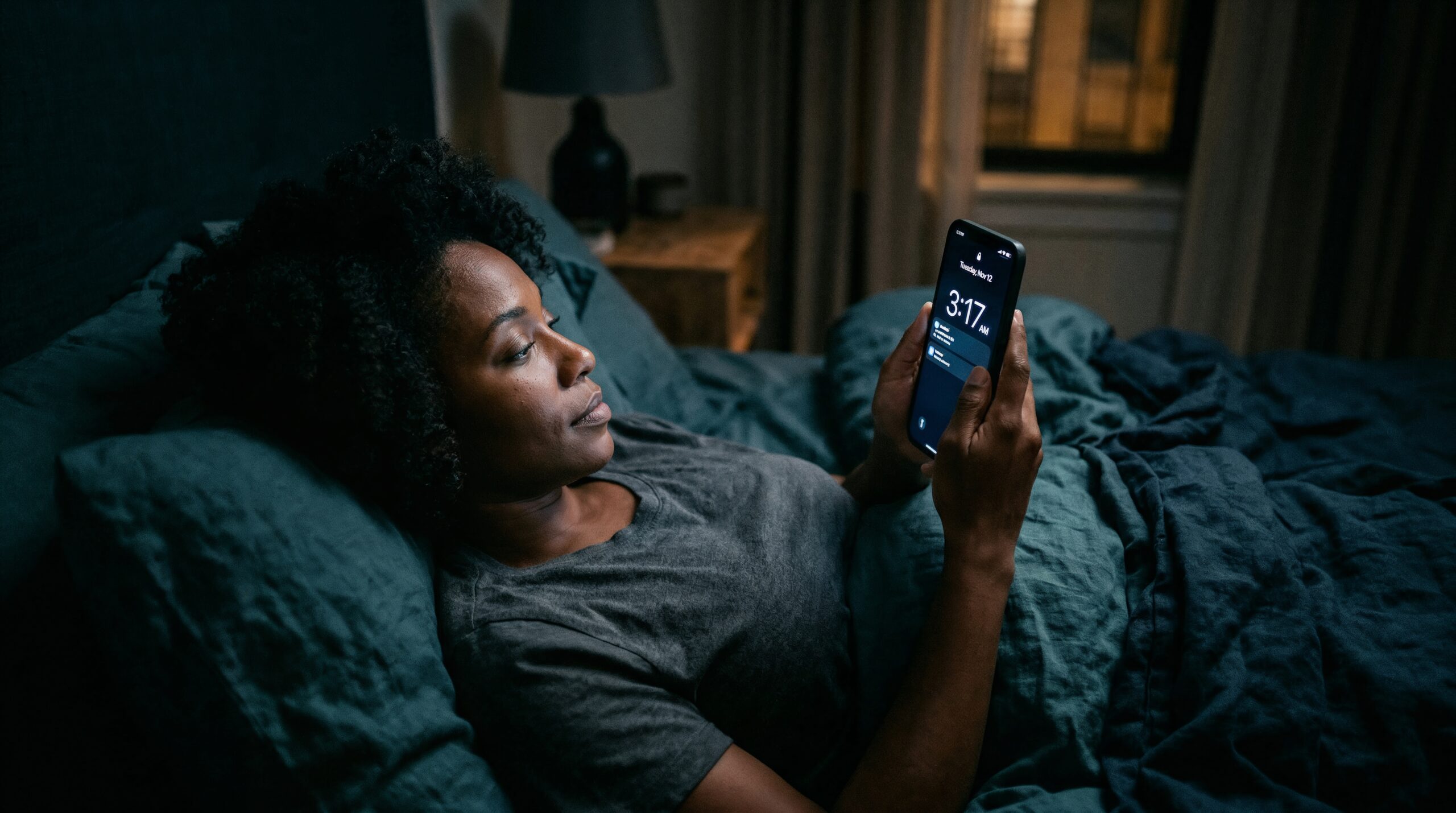
  • Why Do I Keep Waking Up at 3 AM? Causes and Solutions

    Why Do I Keep Waking Up at 3 AM? Causes and Solutions

    Waking up at 3 AM is one of the most common sleep complaints, and if it keeps happening to you, I want you to know you’re not imagining things. There’s actually a reason this specific time is so common.

    The good news? Once you understand what’s causing it, middle of the night waking is usually fixable. In this guide, we’ll look at the most common reasons you’re waking up at 3 AM and what you can actually do about it.

    Want to work with your body’s natural sleep cycles instead of against them? Try our free Sleep Calculator to find your optimal bedtime.

    Why 3 AM Specifically?

    There’s nothing magical about 3 AM, but there is a reason it’s such a common time to wake up.

    If you go to bed around 10 or 11 PM, by 3 AM you’ve completed about three to four sleep cycles. At this point in the night, you’re spending more time in lighter sleep stages and REM sleep, and less time in deep sleep. This makes you more vulnerable to waking up [1].

    Your body temperature also reaches its lowest point around 3 to 4 AM, and cortisol (your stress hormone) starts to rise in preparation for morning. These natural shifts can be just enough to pull you out of sleep, especially if something else is off.

    The Most Common Causes of Middle of the Night Waking

    Understanding why you’re waking up is the first step to fixing it. Here are the most likely culprits:

    1. Stress and Anxiety

    This is the big one. When you’re stressed, your body produces more cortisol. While cortisol naturally rises in the early morning hours, chronic stress can cause it to spike earlier, waking you up and making it hard to fall back asleep [2].

    You might not even feel anxious when you wake up. But if your mind immediately starts racing through tomorrow’s to-do list or replaying yesterday’s problems, stress is likely playing a role.

    2. Blood Sugar Drops

    If you haven’t eaten in many hours, your blood sugar can drop during the night. When it drops too low, your body releases adrenaline and cortisol to bring it back up, and that hormonal surge can wake you.

    This is more likely if you ate dinner early, skipped dinner, or had a meal high in sugar or refined carbs that caused your blood sugar to spike and then crash.

    3. Alcohol

    Alcohol might help you fall asleep faster, but it disrupts the second half of your night. As your body metabolizes the alcohol (usually 3 to 4 hours after your last drink), it causes a rebound effect that fragments your sleep [1].

    Even one or two drinks in the evening can lead to waking up in the middle of the night.

    4. Sleep Apnea

    Sleep apnea causes you to stop breathing briefly throughout the night. These pauses can pull you out of deep sleep, often without you realizing it. You might just wake up feeling like something’s wrong, without knowing why.

    If you snore, wake up with a dry mouth, or feel exhausted even after a full night’s sleep, sleep apnea could be worth investigating with a healthcare provider [2].

    5. Room Environment

    Sometimes the cause is simpler than you think. Your room might get too hot or too cold in the early morning hours. Outside noise (garbage trucks, early birds, traffic) might be louder than you realize. Light creeping in from streetlights or an early sunrise can signal your brain to wake up.

    6. Needing to Use the Bathroom

    This one’s obvious, but worth mentioning. Drinking too many fluids close to bedtime, or beverages that are diuretic (like alcohol or caffeine), can wake you up with a full bladder.

    For some people, especially as they get older, nighttime urination (nocturia) becomes more frequent. If this is a new or worsening issue, it’s worth mentioning to your doctor.

    7. Hormonal Changes

    Hormonal shifts during menstruation, perimenopause, menopause, or even due to thyroid issues can significantly disrupt sleep. Hot flashes, night sweats, and fluctuating hormone levels are common culprits for middle of the night waking.

    What You Can Do About It

    Once you have a sense of what might be causing your wake-ups, you can start addressing it. Here are practical solutions that actually work:

    Stabilize your blood sugar before bed. A small snack with protein and complex carbs, like a handful of nuts, cheese and crackers, or a small bowl of oatmeal, can help keep your blood sugar stable through the night.

    Cut off alcohol earlier. If you drink, try stopping at least 3 to 4 hours before bed. This gives your body time to metabolize the alcohol before you hit the lighter sleep stages.

    Manage stress before it manages you. A simple wind-down routine (journaling, light stretching, deep breathing) can help lower cortisol before bed. If your mind races when you wake up, keep a notepad by your bed to dump your thoughts so they’re not spinning in your head [3].

    Optimize your sleep environment. Keep your room cool (65 to 68°F is ideal for most people). Use blackout curtains or an eye mask. Consider a white noise machine if early morning sounds are waking you.

    Limit fluids before bed. Stop drinking large amounts of water or other beverages about 2 hours before bed. Use the bathroom right before you get into bed.

    Time your sleep cycles. If you’re going to wake up briefly between cycles anyway, you can work with your body’s natural rhythm instead of against it. Our sleep calculator can help you find the best bedtime so you’re more likely to wake up at the end of a cycle, or sleep through to morning.

    What to Do When You Wake Up at 3 AM

    Even with the best habits, you might still wake up sometimes. Here’s how to handle it:

    Don’t look at the clock. Checking the time just increases anxiety about how much sleep you’re losing.

    Stay in bed for 15 to 20 minutes. Keep your eyes closed, breathe slowly, and give yourself a chance to drift back off.

    If you can’t fall back asleep, get up. Go to another room, keep the lights dim, and do something quiet and boring: read a dull book, fold laundry. Avoid screens. Return to bed when you feel drowsy [3].

    Don’t catastrophize. One rough night isn’t a crisis. The more you worry about not sleeping, the harder it becomes to sleep.

    When to Talk to a Doctor

    If you’ve tried these strategies and you’re still waking up consistently at 3 AM, it might be time to see a healthcare provider. This is especially true if:

    • You snore heavily or gasp during sleep (possible sleep apnea)
    • You feel exhausted during the day despite spending enough time in bed
    • You’re experiencing symptoms of depression or anxiety
    • You’re waking up more than once a night to urinate
    • The problem has persisted for more than a few weeks

    A sleep specialist can help identify underlying issues that might not be obvious.

    Frequently Asked Questions

    Why do I wake up at 3 AM every night?
    Waking up at 3 AM is common because you’ve completed several sleep cycles by then and are in lighter sleep stages. Stress, blood sugar drops, alcohol, and environmental factors like temperature or noise are the most common triggers.

    Is waking up at 3 AM a sign of a health problem?
    Not necessarily. Occasional middle of the night waking is normal. However, if it happens consistently and you also snore, feel exhausted during the day, or have other symptoms, it’s worth discussing with a healthcare provider to rule out issues like sleep apnea.

    How can I stop waking up in the middle of the night?
    Start by identifying the most likely cause: stress, blood sugar, alcohol, or your sleep environment. Then address that specific issue. Stabilizing blood sugar with a light bedtime snack, cutting off alcohol earlier, and keeping your room cool and dark can all help.

    Should I stay in bed if I wake up at 3 AM?
    Stay in bed for 15 to 20 minutes and try to relax. If you can’t fall back asleep after that, get up and do something quiet and boring in dim light until you feel drowsy, then return to bed.

    Does what I eat affect my sleep?
    Yes. Eating a large meal close to bedtime can disrupt sleep, but so can going to bed hungry. A light snack with protein and complex carbs about an hour before bed can help keep blood sugar stable through the night.

    The Bottom Line

    Waking up at 3 AM is frustrating, but it’s usually fixable. Start by identifying the most likely cause (stress, blood sugar, alcohol, environment) and address that first. Small changes can make a big difference.

    And remember: your body has natural wake points throughout the night. Working with your sleep cycles, rather than fighting them, can help you either sleep through or get back to sleep faster.

    Ready to find your optimal sleep times? Use our Sleep Calculator to find the best bedtime based on when you need to wake up.

    Sweet dreams. You deserve a full night’s rest. 💙

    References

    [1] Sleep Foundation. Why Do I Wake Up at 3 AM? https://www.sleepfoundation.org/sleep-faqs/why-do-i-wake-up-at-3am

    [2] Cleveland Clinic. Why You Keep Waking Up at 3 a.m. https://health.clevelandclinic.org/why-do-you-always-wake-up-at-3-a-m

    [3] Johns Hopkins Medicine. Up in the Middle of the Night? How to Get Back to Sleep. https://www.hopkinsmedicine.org/health/wellness-and-prevention/up-in-the-middle-of-the-night-how-to-get-back-to-sleep